



















































































































Fabric Shrinkage: How to Measure, Calculate, and Specify It
Fabric shrinkage is a reduction in dimensions after a defined treatment, commonly washing and drying. A useful result identifies the fabric, treatment, number of cycles, measurement direction, and calculation convention. It should not be reduced to an unsupported claim such as “cotton shrinks 5%” or “polyester never shrinks.” The finished construction, processing history, and care conditions all matter. For apparel purchasing, measure length and width separately and compare the result against an agreed specification.
This guide explains why dimensional change matters, how to read a shrinkage calculation, and what to confirm before approving fabric for bulk cutting.
Why fabric dimensions can change
Fabric can carry stresses introduced during manufacture and finishing. When the material is wetted, moved, heated, and dried, its fiber and yarn arrangement may change or relax. Different materials and structures respond differently. The word shrinkage describes the dimensional outcome; it does not identify one universal cause.
The American Chemical Society’s clothing-shrinkage explanation introduces textile chemistry and the importance of care. For product development, avoid assuming that the mechanism and magnitude are identical across cotton, wool, synthetic fibers, and blends. Use the intended fabric and care process as the starting point.
Dimensional change is also broader than shrinkage. A sample can become shorter in one direction and wider in another, or show growth after treatment. Twisting, skew, or seam distortion may affect garment appearance even when the length and width measurements seem acceptable. Keep these observations separate rather than hiding them inside one average number.
Calculate shrinkage with the sign convention stated
A transparent dimensional-change calculation is (dimension after treatment − original dimension) ÷ original dimension × 100. Under this convention, a negative value indicates shrinkage and a positive value indicates growth. Both measurements must use the same units and reference positions.
For example, a hypothetical marked length changes from 500 mm to 480 mm. The calculation is (480 − 500) ÷ 500 × 100 = −4%. If the marked width changes from 500 mm to 490 mm, the width change is −2%. Report both values, together with the treatment and sample identity.
Some commercial conversations state shrinkage as a positive magnitude: “4% length shrinkage.” That can be clear when explicitly labeled, but it should not be confused with a signed dimensional-change report. Agree the convention before transferring results into a specification or spreadsheet.
| Hypothetical measurement | Before treatment | After treatment | Signed change | Plain-language interpretation |
|---|---|---|---|---|
| Length | 500 mm | 480 mm | −4% | 4% shrinkage in length |
| Width | 500 mm | 490 mm | −2% | 2% shrinkage in width |
| Another sample dimension | 500 mm | 505 mm | +1% | 1% growth, not shrinkage |
These are worked arithmetic examples, not test results for a Shengchao product or universal acceptance limits. ISO 5077 concerns dimensional change after specified washing and drying; the measurement result must remain linked to the selected procedure.
Why the washing and drying procedure changes the meaning
Two reports labeled “shrinkage after washing” may describe different treatments. Machine action, temperature, detergent, load, drying route, and the number of cycles can influence the comparison. A line-dried sample and a tumble-dried sample should not be ranked as though they had undergone the same process.
ISO 6330 specifies domestic washing and drying procedures for textile testing. Its public scope makes clear that a complete test includes washing and drying, and that different parameters can affect results. Ask the laboratory to identify the actual procedure and current edition rather than reporting only the standard’s number.
Domestic-care testing is not automatically a substitute for industrial laundering, dry cleaning, or the production wash used by a garment factory. Choose a procedure suited to the claim or use case. If a program changes its care instructions, assess whether the earlier dimensional-stability evidence is still relevant.
Prepare a comparison that answers the buying question
Identify the finished material
Record the article code, batch, color, fiber blend, construction, finish, and finished weight. Confirm whether the sample represents the production-ready textile or an earlier development stage. A test on an unfinished base does not automatically describe the fabric after dyeing, printing, brushing, or another finishing step.
Use reference positions and suitable conditioning
Measurements should come from established reference positions, with the material prepared and conditioned according to the chosen method. Do not pull an elastic sample to make the ruler line convenient. Equally, do not compare a damp, warm specimen immediately from a dryer with an original measurement taken under a different condition.
Keep directions separate
Record lengthwise and crosswise results independently. Use the laboratory’s appropriate direction terminology for the construction. The more favorable direction should not conceal the less favorable one. If several specimens or locations are involved, retain the individual observations alongside the reported summary.
Agree cycles and the decision rule
Specify the number of care cycles, how the result will be summarized, and what happens if a limit is exceeded. More cycles do not automatically make a poorly defined test more useful. A relevant, repeatable procedure tied to the garment’s care expectations is more informative than a long treatment with no clear acceptance basis.
A real product listing is a starting point, not a shrinkage report
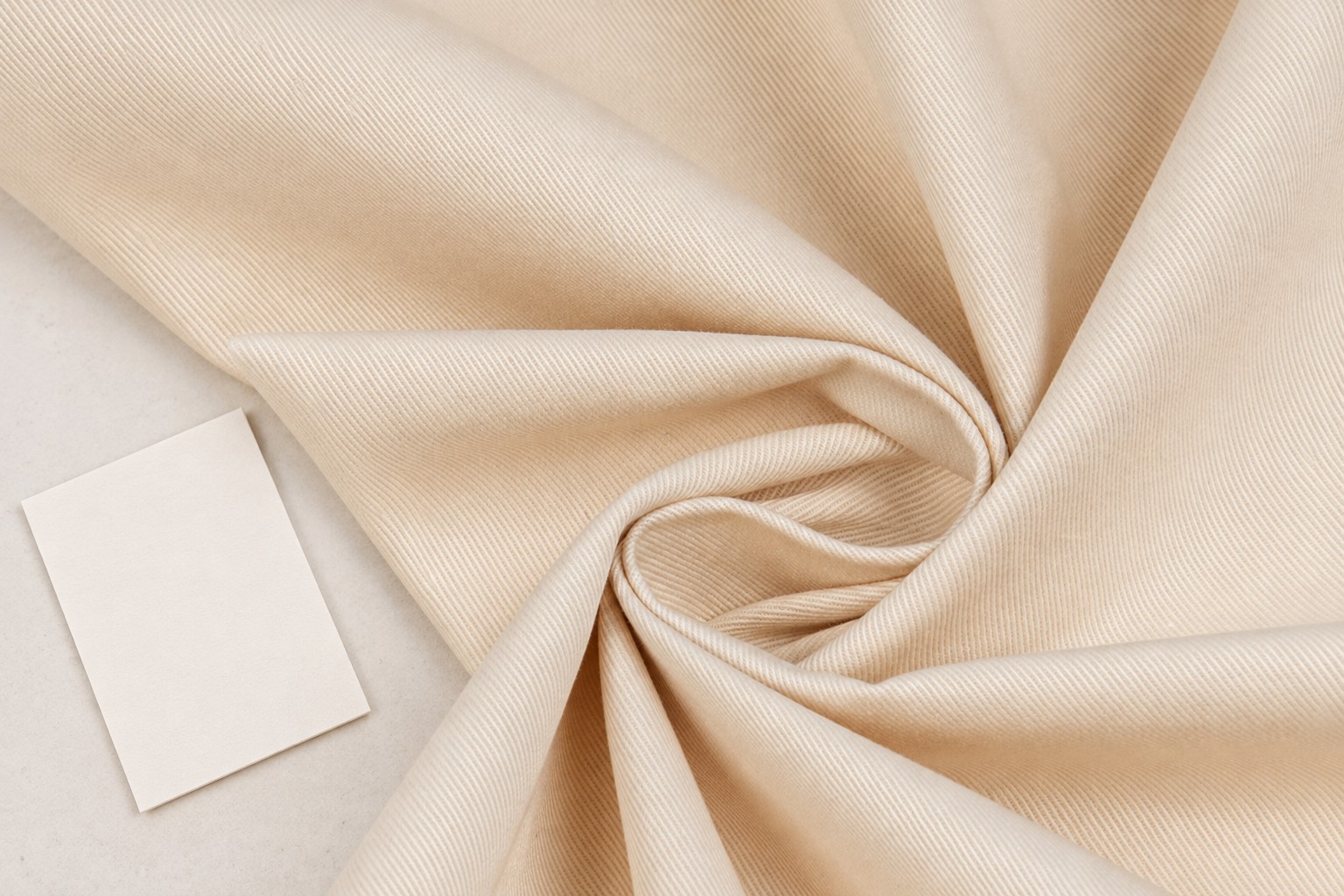
Shengchao’s 100% cotton non-stretch fabric is listed as 100% cotton, 150 cm wide, and 215 g/m². Those details identify a candidate material and support a sampling request. The listing does not provide a measured post-wash length or width change.
Ask for current dimensional-stability information on the finished fabric in the intended care condition. Confirm whether any pre-shrinking or stabilization treatment is specified, and what evidence supports the resulting claim. Do not interpret “non-stretch” as “cannot shrink”: stretch behavior and dimensional change after care answer different questions.
For a school-uniform or workwear program, share the actual laundering expectation and the main fit concern. A material chosen for appearance and hand still needs to be evaluated in the intended garment. Use a representative color and construction where possible, and clarify whether a proposed finish change requires retesting.
How shrinkage affects cutting and fit
If a confirmed development process produces a predictable dimensional change, a patternmaker may need to account for it. A useful planning relationship is required initial dimension = target final dimension ÷ retained fraction. The retained fraction is one minus the shrinkage magnitude expressed as a decimal.
For a hypothetical 4% length reduction, the retained fraction is 0.96. A target final length of 100 cm would correspond mathematically to 100 ÷ 0.96 = approximately 104.17 cm before that treatment. Adding only 4 cm gives 104 × 0.96 = 99.84 cm, which shows why the denominator matters.
This is an arithmetic illustration, not a cutting instruction for every panel. Seams, trims, lining, pattern shape, processing, and direction can require different allowances and decisions. Confirm the complete garment result with the patternmaker and a production-representative sample before changing bulk patterns.
Do not combine length and width shrinkage by simple addition to describe area loss. In the earlier example, the retained area fraction is 0.96 × 0.98 = 0.9408, equivalent to 5.92% area reduction. That calculation does not establish garment yield, because marker efficiency, usable width, defects, and other losses are separate inputs.
Investigate failures before changing the specification
If a result differs from the benchmark, first confirm sample identity and treatment. Check whether the same finished construction, batch, washing route, drying route, conditioning, and measurement positions were used. A recording error or mismatched procedure should be resolved before deciding that a whole fiber family is unsuitable.
Then compare fabric and garment observations. A flat swatch can behave acceptably while seams pucker or shell and lining change differently. Conversely, a fabric result may reveal a problem that a loose prototype initially conceals. Review the complete assembly and keep dimensional change, appearance, and fit as distinct approval items.
Agree any corrective action with the supplier, then verify a new sample. Options may involve a different construction, a finishing adjustment, a care change, or a pattern review. A revised claim should be supported by the relevant result rather than by changing the label alone.
Watch the textile science behind shrinking
ACS Reactions’ “Why Do Clothes Shrink in the Wash?” provides accessible background on fabrics and care. It is an educational explanation, not a performance demonstration of Shengchao’s cotton material. The article’s calculations and purchasing checks remain usable without relying on the video.

Watch the ACS Reactions explanation on YouTube.
What to send with a dimensional-stability requirement
Provide the garment application, finished-fabric identity, expected care, relevant test method, cycles, length and width limits, reporting convention, and approval benchmark. Avoid an unexplained “maximum shrinkage” number that leaves the direction and procedure open to interpretation.
Use our fabric development brief to organize the request. The GSM guide addresses weight and consumption, while the stretch and recovery guide explains mechanical response under loading. For the broader apparel decision, see school-uniform fabric selection or contact Shengchao Textile with your care and fit requirements.
Frequently asked questions
Does non-stretch fabric mean it will not shrink?
No. Non-stretch describes extension behavior, while shrinkage describes dimensional change after a treatment. Request evidence for the care condition you intend to use.
Should shrinkage be reported as a negative number?
In a signed dimensional-change calculation, a decrease is negative. A positive shrinkage magnitude can also be stated clearly, but do not mix the conventions.
Does pre-shrunk fabric have zero remaining shrinkage?
Do not assume so. Ask what treatment was applied and what dimensional-change result is supported under the stated washing and drying procedure.
Can one shrinkage percentage cover both directions?
Only if the specification explicitly defines that reporting rule. Length and width can behave differently, so keep their results separate when making an approval decision.