



















































































































Fabric GSM Meaning: Weight, Calculations, and Buying Checks
Fabric GSM means grams per square meter: the mass of one square meter of fabric. A 160 GSM textile contains 160 grams of material per square meter under the stated measurement conditions. GSM helps buyers compare fabric weight and estimate consumption, but it does not independently establish thickness, opacity, softness, stretch, or durability. To select apparel fabric, read GSM together with composition, construction, usable width, finishing, and the requirements of the finished garment.
This guide explains the calculations behind a fabric specification, shows how weight affects purchasing, and identifies the questions that prevent mistakes when comparing swatches or quotations.
What GSM measures—and what it leaves out
GSM is a mass-per-area value, written more formally as g/m². It allows equal areas of different fabrics to be compared. A whole roll’s weight is not its GSM, because the roll may be wider, longer, or packed on a heavier core than another roll. Likewise, grams per linear meter describes a length of fabric at a particular width, rather than a fixed area.
Higher GSM means greater mass per equal area. It does not automatically mean a denser, thicker, or better textile. Yarn type, loop geometry, surface treatments, and the distribution of material can produce very different hand and drape at the same weight. A brushed knit and a smooth compact knit may feel different even when their measured GSM is similar.
The distinction matters when replacing an approved fabric. If a development brief only says “match 180 GSM,” a supplier could offer a material that meets the weight target but behaves differently in sewing or wear. Keep the approved construction and performance requirements attached to the weight specification.
How to calculate fabric GSM from a sample
The basic relationship is GSM = sample mass in grams ÷ sample area in square meters. For a rectangular piece, calculate area from length multiplied by width, with both dimensions expressed in meters. Weigh only the fabric, without a paper backing, label, clip, or container.
For example, a relaxed sample measuring 20 cm by 20 cm has an area of 0.20 × 0.20 = 0.04 m². If its mass is 7.2 g, the calculated weight is 7.2 ÷ 0.04 = 180 g/m². This is a worked arithmetic example, not a test result for a Shengchao product.
A 100 cm² specimen has an area of 0.01 m², so its mass in grams is multiplied by 100 to calculate GSM. The multiplier only works when the actual specimen area is 100 cm². A circular cutter is not automatically that size: confirm its specified cutting area and condition rather than assuming every cutter uses the same conversion.
For commercial testing, ask the laboratory to select an appropriate fabric mass-per-area procedure and sampling plan. ASU FIDM’s textile testing laboratory, for example, lists fabric weight assessment among its capabilities. Confirm whether the result represents a full-width sample, a small swatch, or a wider sampling plan. A small swatch result should not be treated as proof of uniformity throughout an entire shipment.
Convert GSM into grams per meter or meters per kilogram
A purchase quotation often uses kilograms, while cutting plans use meters. To connect them, you need the finished width. For an uncoated single fabric of uniform nominal weight, the planning relationships are:
- Grams per linear meter = GSM × width in meters.
- Meters per kilogram = 1,000 ÷ (GSM × width in meters).
- Fabric mass in kilograms = GSM × width in meters × length in meters ÷ 1,000.
Consider a hypothetical 180 GSM fabric that is 1.60 m wide. One linear meter weighs 180 × 1.60 = 288 g. The theoretical yield is 1,000 ÷ 288 = approximately 3.47 m/kg. A 100 m length would contain approximately 28.8 kg of fabric. These calculations exclude cores, wrapping, moisture differences, defects, and cutting losses.
| Planning example | GSM | Width | Mass per linear meter | Theoretical yield |
|---|---|---|---|---|
| Example A | 160 g/m² | 1.80 m | 288 g/m | 3.47 m/kg |
| Example B | 180 g/m² | 1.60 m | 288 g/m | 3.47 m/kg |
| Example C | 230 g/m² | 1.60 m | 368 g/m | 2.72 m/kg |
These are calculated examples using the formulas above, not measured production yields. Examples A and B show why GSM alone cannot determine meters per kilogram: a wider, lighter fabric can have the same mass per linear meter as a narrower, heavier one.
GSM versus ounces per square yard
Some fabric specifications use oz/yd². For ordinary comparison, 1 oz/yd² is approximately 33.906 g/m². Divide GSM by 33.906 to estimate ounces per square yard; multiply ounces per square yard by 33.906 to estimate GSM. For example, 180 GSM is approximately 5.31 oz/yd².
This conversion follows the international pound and yard definitions documented in NIST’s conversion guidance. It is not the same as ounces per linear yard, which also depends on fabric width. Confirm whether a supplier means square-yard weight or linear-yard weight before comparing numbers.
Choose weight around the garment, not a universal chart
There is no single GSM that makes every T-shirt, legging, or swimsuit suitable. A lightweight layer may need low bulk and easy drape, while a fitted bottom may prioritize coverage under extension. Composition, construction, color, and lining can change the outcome, so broad “light,” “medium,” and “heavy” categories are only convenient descriptions.
Start with a benchmark garment and identify what needs improving. If a T-shirt feels too heavy, compare lighter candidates with a similar construction rather than changing weight, fiber, and knit simultaneously. If leggings become transparent when stretched, assess coverage at the actual extension; increasing GSM may help some constructions but does not guarantee a solution.
For a wider selection framework, read our sportswear fabric guide. The T-shirt fabric selection guide and yoga-pants fabric guide explain garment-specific priorities. Here, the focus is understanding and checking the weight value rather than ranking materials.
Read a real product specification carefully
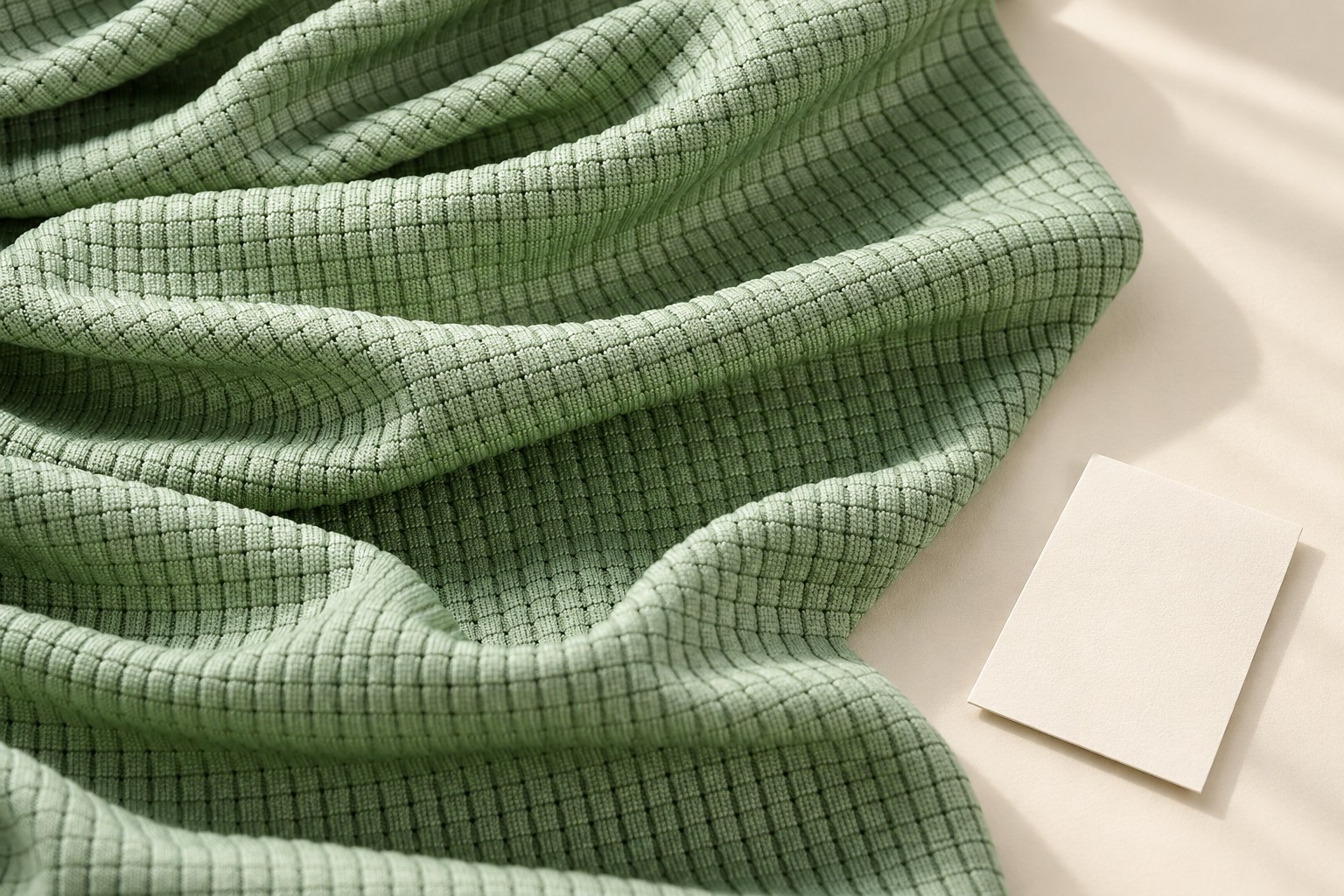
Shengchao’s moisture-wicking polyester fabric is listed as 100% polyester, 160 g/m², and 180 cm wide. At those nominal values, the calculation gives 288 g per linear meter and approximately 3.47 m/kg. The product page rounds its conversion to 3.5 m/kg, which is consistent with that planning estimate.
The listed GSM identifies the product’s nominal weight; it does not prove that each roll measures exactly 160 g/m² or supply an agreed acceptance tolerance. Request the current finished specification, usable width, and batch inspection information before fixing consumption or purchasing quantities. Ask whether any weight or width tolerance applies to the quotation.
Also distinguish full width from usable width. Total fabric mass can include edge areas that cannot be used in the marker. If the mill reports full-width weight while the cutting plan assumes usable width, document the difference so the theoretical yield is not mistaken for guaranteed garment output.
How to check GSM without misleading yourself
Use representative material
Confirm the fabric code, lot, color, and finish before cutting specimens. Avoid selecting only a visibly unusual section or relying on one showroom cutting. Agree where and how samples will be taken when lot acceptance is involved. Repeated measurements can reveal variation, but the sampling plan must support the conclusion you want to draw.
Keep the sample relaxed
Stretching a knit while measuring or cutting changes its area. That can distort the calculated GSM, especially when a soft elastic material is pulled flat by hand. Lay the material without deliberate tension and follow the conditioning and preparation instructions of the selected test procedure.
Control weighing and moisture conditions
Use a suitable balance, a verified specimen area, and consistent conditioning. A very small specimen makes cutting and balance errors more influential. Moisture can also affect measured mass, so a freshly steamed cutting should not be compared casually with a stored dry sample. Record the measurement basis rather than reporting a bare number.
Agree tolerances before approving bulk
Do not invent a universal tolerance. Specify the target, permitted variation, test method, sampling approach, and action for an out-of-range result. When two laboratories disagree, first compare sample identity and procedure. A change in finished weight should trigger a review of width, hand, shrinkage, and garment consumption as appropriate.
Watch a fabric-weight measurement demonstration
The educational video below, “Measuring GSM of cloth” by Cloud Weave, demonstrates the fabric-weight measurement task. Use your laboratory’s agreed procedure for the specific fabric and commercial acceptance decision.
Watch the measurement video on YouTube.
Frequently asked questions
Does higher GSM mean better quality?
No. It means more mass per equal area. Quality depends on whether the fabric meets the garment’s requirements for appearance, comfort, stability, and performance.
Is GSM the same as fabric thickness?
No. GSM measures mass per area. Thickness is a separate dimension influenced by structure, surface treatment, and the pressure used during measurement.
Can GSM tell me how many meters are in a kilogram?
Only when width is also known. The theoretical calculation is 1,000 ÷ (GSM × width in meters). Confirm the width basis and exclude packaging.
What should I send with a GSM requirement?
Provide the garment, composition, construction or benchmark, usable width, finishing, target weight, agreed tolerance, and test requirements. Use our development brief checklist or contact Shengchao Textile to organize the sampling request.