



















































































































What 100 Organic Cotton Jersey Knit Fabric Actually Asks For
100 organic cotton jersey knit fabric is three buying lines written as one name. The lines are fiber percentage, organic chain of custody, and a jersey stitch.
A page that says the cloth is all cotton has finished only the first line. Certificate paperwork and the stitch name are still open questions. People who type cotton fabrics are usually trying to sort that stack before they pick a roll.
Three different promises sit inside one fabric name
The name bundles a fiber percentage, an organic custody path, and a jersey stitch. Each promise can be true while the other two are still blank.
Retail titles like to fuse them. A listing can say organic, cotton, and jersey in the headline, then put the real details in a spec block or in a later paragraph.
The headline is a nickname. The spec block is the order.
Buyers feel this when a tee program, a kids’ set, or a casual woven-look shirt all get the same fabric phrase pasted into the email. The phrase sounds specific. It still leaves the mill free to send ordinary cotton, a blend, or a knit that is rib or interlock.
Think of the phrase as a three-row form that arrived with the rows already merged. Pull the rows apart before anyone quotes a price.
Fiber tells you what the yarn is. Custody tells you which farm-to-goods path was audited. Construction tells you how the loops were built.
That split also explains why two honest suppliers can both answer “yes” and still be offering different cloth. One is selling all-cotton single knit with no certificate in the file.
Another is selling certified organic fiber in an interlock that a catalog nicknamed jersey. Both answers fit parts of the phrase. Neither answer fits all of it.
A 100% cotton line only settles the fiber
It says the fiber is cotton. Farming method and stitch stay outside that sentence.
Under the Federal Trade Commission cotton guidance, a product should not be labeled 100% cotton unless it contains only cotton, aside from trim the rules allow.
That same guidance shows a label written as 96% cotton and 4% spandex when spandex is part of the cloth.
Spandex is a fiber name, the way cotton is a fiber name. US labels use spandex when that fiber is in the goods.
A jersey stitch does not sneak spandex into the cloth, and a cotton percentage does not erase it. If the label lists only cotton, the fiber story stops at cotton. When a hand-feel seems unusually snappy, read the full fiber line again.
The small-fiber listing rule is why a tiny share of another fiber can still show up by name when it does a job. You do not need that rule to read an all-cotton line. You need it when a program tee is supposed to hug and the swatch feels different from the last bulk.
A community thread made the same cut from the other direction. People said an all-cotton label tells you what the thread is, and stays quiet about the path from field to finished goods.
That quiet is the gap the next section fills. It is also why “organic” cannot be inferred from a cotton percentage, however round the number looks.
Organic cotton is a custody claim, not a knit
Organic, under OCS and GOTS, is certified fiber plus a chain, with label grades at set percentages. The knit type is a different sentence.
OCS is a voluntary chain of custody standard. It follows material that started on a farm certified to a recognized organic standard, through later businesses, to the goods being sold.
The standard is about that path. Softness is a separate judgment.
An OCS 100 product has at least 95% certified content and at most 100% certified content, and any remainder has to be a different material type.
Read that remainder rule slowly. Organic cotton mixed with ordinary cotton is still cotton mixed with cotton.
The manual says an OCS 100 logo is off the table for that mix, even when the organic share is high. A shirt that pairs organic cotton with a different material, such as recycled polyester, is the sort of remainder the logo text allows.
The percentage and the material types both matter.
GOTS version 8.1 covers textiles made from at least 70% certified organic natural fibres.
The GOTS organic label grade is for products with at least 95% certified fibre content, excluding accessories.
GOTS also reaches into processing, past the farm gate. A buyer who says “organic cotton” still has to name the standard.
OCS and GOTS are different stamps. A mill can be telling the truth about fiber content and still have no transaction certificate and no license number to send.
When the email says “we use organic cotton,” ask which standard, which certified entity, and which document travels with the lot. A farming slogan is a different kind of sentence from a lot document.
Color work is its own request, after the fiber and the custody lines are clear. Dye steps belong in that later request, not inside the fiber percentage.
Jersey is a stitch, and a machine slogan is not that stitch
Jersey is the all-knit single stitch with a different face and back. A generic machine sentence does not name it.
CottonWorks jersey teaching describes the cloth this way. Jersey fabrics use the knit stitch across each course.
The face shows columns of wales. The back shows rows of crowns. Every course repeats that same knit stitch.
Wales and crowns are the practical check: one side looks like fine vertical ribs, the other like fine horizontal bumps.
CottonWorks also says the stretch across the width runs about twice the stretch along the length, and that a cut across the width tends to curl and run. Treat that as a description of the stitch family.
It applies to jersey as a construction. It does not measure any one Shengchao roll, and it does not show that a cotton page was knitted this way.
From the field: A sewing-forum reader thought all-cotton socks should not spring back. The replies called that mechanical stretch: the loops move, and the yarn itself is not what stretches. Source: archived r/Fabrics discussion.
Spandex is what those readers associated with extra snap. The basic loop stretch is already there when the fiber line is all cotton.
Interlock is the easy mix-up. On the same CottonWorks page, interlock is two rib structures locked together.
Face and back look alike. The cloth is stabler and curls less than single jersey. Rib is another double knit, with its own width stretch.
French terry and pique sit in that family of types of cotton knit fabrics. A shorter title does not turn those stitches into jersey.
A supplier page can mention machines in a general paragraph and still never name the stitch. Warp-knitting language, weaving-machine language, and a circular-knit jersey are three different shop-floor stories.
If the page does not say jersey, rib, interlock, or another stitch, the construction line is still blank. You confirm it with a face-and-back photo, a knit diagram, or a written stitch name.
A slogan that also appears on unrelated cloth leaves the stitch line blank.
Retail pages already split these lines, and sometimes mix them
Some shops use separate cards. One title says jersey while the cloth is described as interlock.
On a live knit collection, “100% cotton jersey” sits beside organic cotton ribs, organic cotton blended with spandex, and other knits. The cards are the split. The collection title leaves that work undone.
A cotton category at another shop mixes classic cotton jersey, organic cotton rib, and cotton spandex jersey in one list. Again the product table does the work the headline skips.
The sharp case is a product titled as a luxe organic cotton jersey whose own description calls the cloth an interlock, with identical face and back, made from organic cotton. The title borrowed “jersey.” The paragraph named a different stitch. A buyer who orders from the title alone can be right about fiber and wrong about construction.
Search pages add a further muddle. A marketplace query for the full phrase can return thousands of print designs that only look like jersey texture.
Those hits are artwork on a substrate menu. A mill spec is a different document. The related search “100 cotton jersey knit fabric by the yard” shows how often the next click is a shopping errand.
Yardage is a fair thing to buy. It still leaves the three lines to be read one by one.
| Line on the request | What you are settling | A useful reply |
|---|---|---|
| Fiber | Cotton share, and any other fiber such as spandex | Generic names and percentages |
| Custody | Organic path, if you need one | Standard name plus the certificate that matches the lot |
| Construction | Jersey, interlock, rib, or another stitch | Face and back, or a written stitch name |
A usable request lists fiber, custody, and construction apart
Ask for fiber, the custody document, the stitch name, the end use, the color state, and the weight as separate lines. Leave a line blank if you do not need it. Do not let the blank line inherit an answer from the line above.
End use keeps the weight honest. A draped summer top and a heavier casual tee can both be cotton, and they should not be forced into one weight sentence.
Color state matters too: dyed, undyed, or a print ground. Say which one you mean.
Prints for fashion and casual garments are a common end use for cotton shirting and tee programs, and they belong in the end-use line, not inside the fiber percentage.
Weight belongs in its own cell because suppliers publish options. When a page lists more than one weight, you are choosing, not discovering a hidden average. Width belongs beside weight so the marker and the cut plan match.
Here is a compact way to send it.
| Request line | Example of a clear answer | Example of a gap |
|---|---|---|
| Fiber | All cotton, no other fiber named | “Cotton rich” with no percentages |
| Custody | A named standard and a lot document, or an honest “none” | “Eco cotton” with no standard |
| Construction | Single jersey, with face and back noted | A machine slogan and no stitch name |
| End use and color | Casual tee, dyed, print ground | “Any apparel” |
| Width and weight | One width and one chosen weight | A range copied without a choice |
If you are shopping the phrase “100 cotton jersey knit fabric by the yard,” read the product table before the cart. Content, width, weight, and stretch show up there when the seller is being specific.
Certificate names show up only on some cards. Stitch names show up when the seller bothers. A missing line is still information.
A plain 100% cotton cloth still fits when the other two lines are open
The 100% Cotton Fabric page states composition, width, three weights, a 32s yarn highlight, color fastness, and prints for fashion and casual garments.
The 100% Cotton Fabric page states composition 100% cotton, width 185 cm, and weights of 130 / 160 / 180 g/m².
Those three weights are options printed on that page. They belong to this cotton cloth, separate from any organic jersey program.
The 32s yarn note is the page’s way of describing a fine cotton yarn and a soft hand. Color fastness is stated as a highlight, with no test method or grade number beside it.
The print line points at fashion and casual garments. Put that end use on the request if it matches your program.
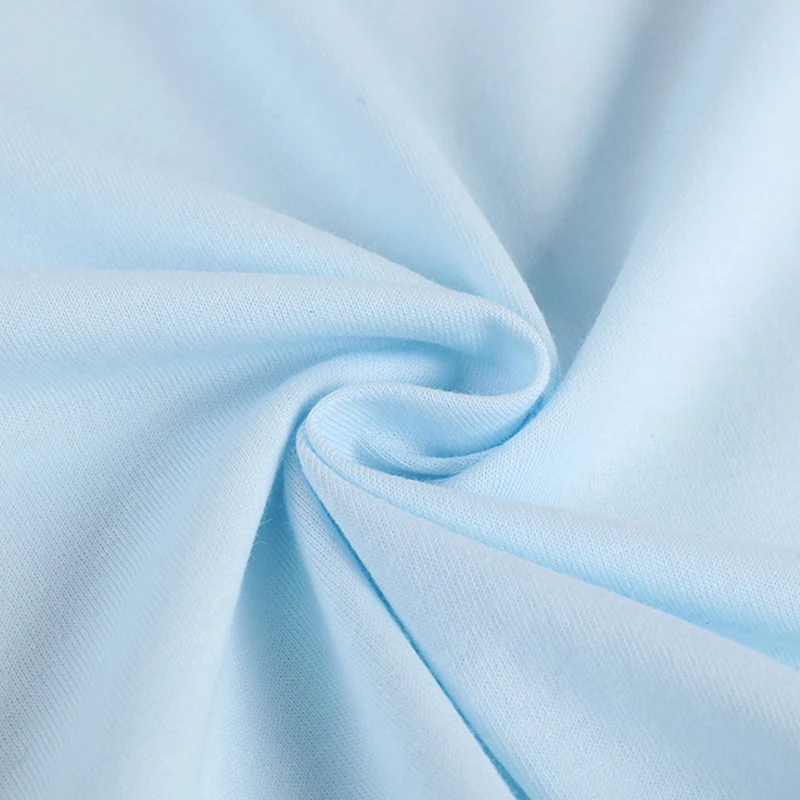
Use this cloth when the fiber line is the line you are ready to place. The page is in the dyed-fabric path and the cotton family. It is a fit for a buyer who wants all-cotton goods, a stated width, and a choice among those three weights, including print work for fashion and casual styles.
Keep writing the other two lines if you still need them. Ask for the custody document when organic content is part of the purchase.
Ask for the stitch name when the garment has to be jersey rather than interlock, rib, or another knit. The cotton page does not close those lines for you.
Choosing it is still a real decision: you have a published composition, a width, and a weight list you can point to, instead of a fused nickname.
If the program later adds spandex, write a new fiber line. If the program later needs a GOTS or OCS lot, write a new custody line.
Either change deserves its own confirmation. The cotton cloth remains available for the job its page actually describes.
FAQ
Can jersey knit be 100% cotton?
Yes. Jersey names the stitch, and cotton names the fiber.
An all-cotton jersey is a normal retail product. The cotton percentage does not create the stitch, and the stitch does not change the fiber label.
What is 100% cotton jersey fabric?
It is cloth whose fiber line is cotton and whose construction is the single-knit jersey stitch, with wales on one side and crowns on the other. You want both facts from the seller. One fact does not include the other.
Is organic jersey cotton good?
“Good” is the wrong grade. The phrase can mean certified organic fiber, a jersey stitch, or both.
Quality for your program depends on which of those you need, plus weight, width, and end use. A custody standard speaks to the path, while softness is something you judge on a swatch.
Can you get 100% cotton jersey?
Retail pages do sell it, often by the yard, with content and weight on the product card. A supplier page that only states all-cotton fiber has not yet said the cloth is jersey. Ask for the stitch if jersey is what the garment needs.
Does a 100% cotton label prove the cotton was grown organically?
No. The label is a fiber-content statement. Organic growing, and any chain of custody after the farm, sit in a different document.
OCS and GOTS are examples of standards that speak to that path. A cotton percentage does not replace them.
Why can a cotton tee stretch when the label lists no spandex?
Because a knit loop can flex. CottonWorks describes jersey as stretching more across the width than along the length, and forum readers call that mechanical stretch.
Spandex would be an extra fiber on the label if it were in the tee. Its absence does not freeze the loops.
What should a buyer ask when a page states 100% cotton, a width, and three weights?
Choose one weight, confirm the width, and say the end use and color state. Then ask, as separate lines, whether any custody document applies and which stitch the cloth is.
The published numbers answer composition, width, and the weight list. They leave custody and construction for you to request.
References
- Federal Trade Commission, Calling It Cotton: Labeling and Advertising Cotton Products.
- CottonWorks, Single and Double Knits.
- Textile Exchange, Organic Content Standard user manual, OCS 3.1.
- Global Standard, Global Organic Textile Standard, Version 8.1.
- r/Fabrics, why all-cotton knits can still flex (archived copy).