



















































































































What 4 Way Stretch African Print Fabric Actually Asks
4 way stretch african print fabric stacks three buying jobs in one search string. Those jobs are four-way stretch, an African-print or wax-print design family, and a named ground cloth.
A shop title can fuse all three. A mill overview can answer fiber, weight, width, yarn, and digital printing while leaving wax naming and a four-way hangtag blank. Buyers who open printed fabric are usually trying to unstack those jobs before they lock a roll.
Shoppers also type 4 way stretch african print fabric by the yard when they want a cut length this afternoon. That shopping habit is real. It still does not turn three different asks into one SKU.
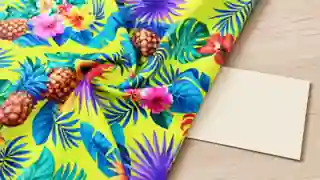
Three buying lines sit inside one fabric name
The name holds four-way stretch, an African-print motif, and a ground cloth. Any one of those can be true while the other two stay blank.
Retail carousels like to fuse them. The same search returns nylon-spandex “African print” knits, polyester DTY jerseys marked 2-way, and 6-yard Ankara packs that never mention stretch.
The title is a nickname. The table under it is the order.
A dance-costume cutter, a leggings developer, and a tailor building a structured wrapper can all paste the same phrase into an email. The phrase sounds finished. It still leaves the mill free to send wax cotton, a slick nylon knit, or a drapey polyester jersey.
Treat the phrase as three form fields that arrived glued together. Unglue them before anyone quotes a price.
Stretch direction tells you how the cloth moves. Print family tells you whether you mean wax-style cotton or a motif sitting on another ground. Fiber and print process tell you what the roll actually is.
Two mills can say yes to the same email and still ship different rolls. One sends colourful cotton in traditional piece lengths.
Another ships nylon and spandex with a digital motif on the face. Each mill answered part of the nickname. Neither mill answered the whole nickname.
Four-way stretch is a direction claim, not a print
It says the cloth gives crosswise and lengthwise. Motif and fiber stay outside that sentence.
Stretch fabric writing puts the cut this way. Two-way stretch usually runs in one direction, often from selvedge to selvedge. Four-way stretch runs both ways, crosswise and lengthwise.
Hangtags name axes here, not kente, mudcloth, or wax.
US labels use spandex for the elastic filament that shops also brand as Lycra. A nylon-spandex blend can be built for four-way movement, and a cotton jersey can flex from looping even when the fiber line has no spandex.
Mechanical stretch comes from knit looping. The extra filament is a different fact on the label.
Swap a one-axis cloth into a both-axis pattern and the garment feels locked. The reverse mistake is just as common: a wax-cotton wrapper program does not become four-way because someone typed stretch into the subject line.
Pull a marked length along the width, then along the length. If only one axis moves, the four-way word in the title has not been earned.
Leave percentages off the email until a mill actually states them. Direction comes first. A number without an axis is another fused nickname.
African print usually names a cotton wax family
Ankara and Dutch wax are colourful cotton prints; true wax is known for two-sided colour. That is the family most people mean when they say African print.
African wax prints are industrially produced colourful cotton cloths with batik-inspired patterning. Trade names include African wax print, Dutch wax print, and Ankara.
One hallmark of true wax is similar colour intensity on the front and the back. Fancy print and other industrial imitations are cheaper copies; costly designs in that group are printed digitally and often show the motif on one face only.
That is why a batik-flavoured title on a stretch knit can still be a one-sided digital motif. The look traveled. The wax bath did not.
Cotton printed fabric by the yard is the older retail path for this family: cotton ground, piece lengths, structure for wrappers, shirts, and dresses. Stretch knits that borrow the same drawings are a later overlay.
From the field: A sewer on r/MAKEaBraThatFits wrote “I used ankara fabric. It is non stretch,” and treated it as a stable woven — archived thread.
Another sewing thread placed African Ankara, wax print, and related cottons with structured garments, not with swim-spandex. If your garment needs a hug around the hip and a squat at the knee, wax cotton is the wrong family until someone actually changed the ground.
A nylon-spandex print can still carry a kente-like drawing. Call it a printed stretch knit. Keep Ankara for the cotton wax family unless the mill writes wax on the overview.
| Line in the search phrase | What it settles | What it leaves open |
|---|---|---|
| Four-way stretch | Give on both axes | Fiber, motif, print process |
| African print / Ankara / wax | Usually a cotton wax family, often two-sided | Stretch, nylon content, digital one-face prints |
| Ground cloth | Nylon-spandex, polyester jersey, or cotton | Whether the other two lines are true |
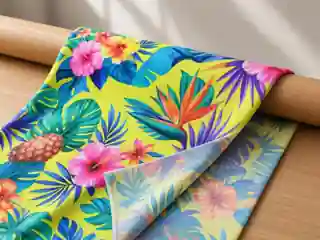
Shops already split these lines, and titles still mix them
Some shops use separate fields. One title says batik while the cloth is described as one-sided digital print.
A US nylon-spandex listing in this search puts content, width, weight, and “Stretch Direction: 4 Way” in a table, then still leads with African print in the H1. The table is doing the split. The title is doing the fusion.
A collection page sells unwaxed 100% cotton African prints at one width next to brushed stretch polyester-spandex jersey at another width, under one African Print Fabrics heading. Motif family is the umbrella. Ground cloth is the fork.
The sharpest mismatch is a cotton-spandex card titled batik that then says the cloth is digitally printed in a batik-style print, with no wax, and colour on one side of a white base. The seller unstacked the process. The title had stacked it first.
Amazon’s results page for the same query mixes 2-way polyester knits, 4-way nylon-spandex, and non-stretch Ankara wax packs. If you buy from the phrase alone, you are bidding on a nickname.
Read the fiber line, the print process, and whether stretch is named as two-way or four-way.
Then look at the photo’s reverse if you care about two-sided colour. Those reads take a minute and they save a wrong bulk.
A usable request lists stretch, print family, and ground cloth apart
Ask stretch direction, wax versus digital motif, fiber, width, and weight as separate lines. End use sits next to those lines, not inside the nickname.
Google’s overview for this query already splits nylon-spandex athletic prints from softer polyester DTY knits, then asks what garment you are making.
Keep that fork: swim and dance want a slick nylon-spandex hand, while a flowy skirt often wants a different jersey.
Write the request as a short list:
- Stretch: two-way or four-way, and which axis matters for the garment
- Print family: wax/Ankara cotton, or a digital motif on another ground
- Fiber: nylon and spandex percentages, or cotton, or polyester
- Process: digital printing, reactive print, or wax
- Width and weight as the mill states them
- End use: swim, leggings, dress, wrapper
Fancy print belongs on the process line when you mean a one-sided industrial imitation of wax. Digital printing belongs there when the mill’s overview already uses that word.
Do not paste the whole search phrase into the subject and hope the mill unpacks it. Unpack it yourself. The mill can then match a roll instead of matching a slogan.
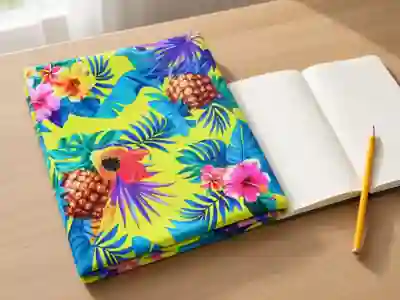
Choose a digitally printed nylon-spandex cloth when wax and 4-way stay open
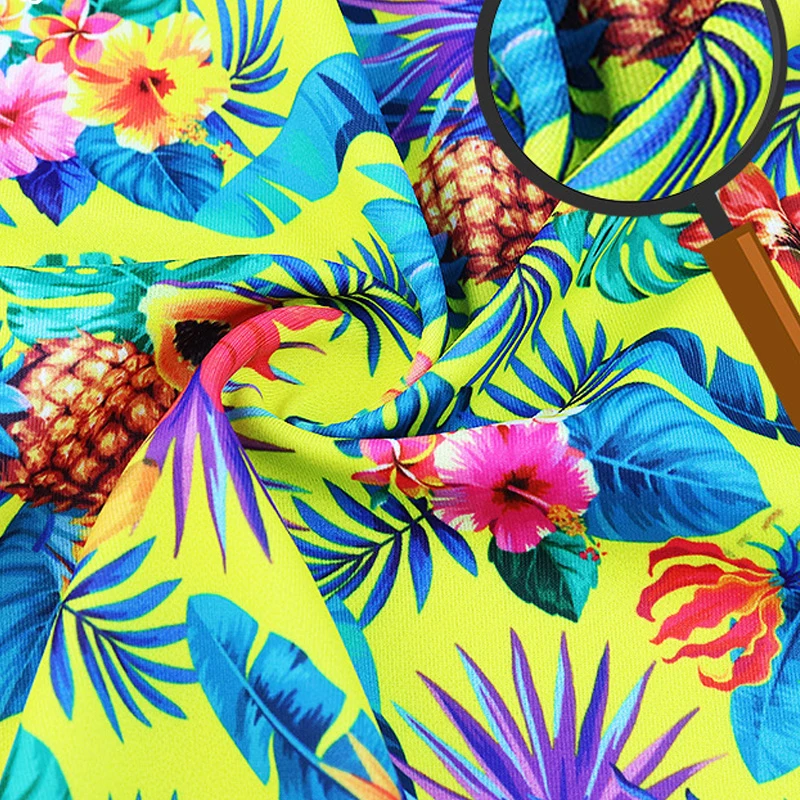
The digital nylon-spandex page states composition, 210 g/m², 40D, 152 cm, and Digital Printing. Those are the closed lines. Wax naming and four-way remain open.
Digital Printed Nylon Spandex Fabric sits on the Printed Fabric hub. The overview lists Composition 22% Spandex, 78% Nylon.
Weight is 210 g/m².
Yarn count is 40D. Width is 152 cm.
Printing is Digital Printing.
US textile labels treat that nylon and spandex pair as a fiber-content statement, in order of predominance by weight. The statement does not name Ankara, and it does not name stretch direction.
If you need colourful printed stretch for a close-fitting fashion or performance sample, this cloth is a live mill option with those five fields already published. If you need two-sided wax cotton, look at a cotton print card instead of relabeling this one.
Cotton African Wax Fabric is a separate printed-cotton item on the same hub. Use it when the brief is cotton print, not when the brief is nylon-spandex stretch.
| Published field | What the mill page states | Still a separate ask |
|---|---|---|
| Composition | 22% Spandex, 78% Nylon | Four-way hangtag |
| Weight | 210 g/m² | Wax or Ankara naming |
| Yarn count | 40D | Two-sided colour like true wax |
| Width | 152 cm | Piece length in traditional wax yards |
| Printing | Digital Printing | Wax-resist process |
Picking this roll is still a concrete mill decision: fiber pair, weight, yarn count, width, and print process are already on the overview.
If the program later needs a named four-way elongation, write that as its own line. If the program later needs Ankara cotton, write a cotton print line.
Either change deserves its own confirmation. The nylon-spandex cloth remains available for the job its overview actually describes.
FAQ
What is four-way stretch fabric called?
It is usually called 4-way stretch, or four-way stretch. The elastic fiber on a US label is spandex.
The name describes both-axis give, not a print family.
What is African print fabric called?
Common names are African wax print, Dutch wax print, and Ankara. Those names point at colourful cotton with batik-inspired patterning.
Stretch knits that copy the drawings still need their own fiber and process lines.
What is the difference between two-way stretch fabric and four-way stretch fabric?
Two-way stretch usually means one axis, often selvage to selvage. Four-way stretch means crosswise and lengthwise.
A title that says stretch has not yet chosen between those two.
Does a nylon-spandex print count as African wax?
No. Wax in this trade talk is a cotton print family with a batik-inspired process and, on true wax, similar colour on both faces.
A digitally printed nylon-spandex cloth is a printed stretch knit. Keep the names on different lines.
Can Ankara fabric be 4-way stretch?
Classic Ankara is treated by sewers as a non-stretch cotton woven, with only bias give. Some shops sell stretch knits printed with Ankara-like motifs.
Ask which ground you are buying. The motif does not create four-way movement by itself.
Does Hobby Lobby have 4 way stretch fabric?
The live People Also Ask answer said some nylon-spandex knits in their knit catalog can be four-way, and stock varies by location.
That is a craft-store inventory note. It is not a mill spec for a printed nylon-spandex program.
What should a buyer ask when a page states 22% spandex, 78% nylon, and digital printing?
Keep those three facts, then add width, weight, and yarn if the overview lists them. Ask stretch direction and wax-versus-digital motif as extra lines if those jobs matter.
The published fiber and digital printing lines do not close the wax name or a four-way hangtag.
How should I wash African wax print fabric?
Wax-cotton care is a different line from nylon-spandex care. Follow the mill or garment care label for the ground you actually bought.
Do not copy a wax-cotton wash habit onto a digitally printed nylon-spandex roll unless that roll’s care line says so.
References
- Wikipedia, Stretch fabric.
- Wikipedia, African wax prints.
- Federal Trade Commission, Threading Your Way Through the Labeling Requirements Under the Textile and Wool Acts.
- r/MAKEaBraThatFits, Ankara described as non-stretch (archived copy).