



















































































































How Sweat Load Changes the Best Sweat Wicking Fabric
For a next-to-skin gym job, the best sweat wicking fabric is a knit that carries liquid sweat off the skin so it can evaporate, and a nylon-spandex fitness cloth is worth pricing only after the buyer asks for the moisture-transport result the spec card leaves off.
Ranked explainers name polyester first and mention nylon when the cloth also has to stretch. A mill buyer still has to read composition, yarn, weight, and end use, then notice the transport line that was never printed. The path below stays on that gym-knit decision and on the moisture-wicking fabric catalog that holds the example.
What a sweat-wicking knit is doing during a workout
The cloth’s job is to carry liquid sweat off the skin so the face can let it evaporate.
Sweat on the skin is already doing the cooling work. Trouble starts when the knit holds that water against the body, so the shirt feels stuck and the cooling arrives late or all at once. Capillary action is the plain mechanism: liquid moves through the small spaces between fibers toward the outer face.
A science-forum commenter put the same job in wearer language. The point of the movement is a less sticky skin feel, with moisture at the surface where air can take it away.
That describes the cloth. A dry shirt at the end of a hard session is a separate hope.
From the field: On a science forum, a commenter said wicking is capillary action whose goal is to move sweat off the body so the cloth feels less sticky while moisture reaches the surface and can evaporate (capillary-action discussion).
Cotton shows the opposite habit. Water goes into the fiber, the fiber swells, and the shirt stays heavy.
Polyester and nylon are chosen because the fiber core takes up less water and the liquid can travel along the yarn instead. Which of those two synthetics you price depends on the garment, rather than on a single winner board.
Why polyester sweat wicking is the common gym default
Polyester is the fiber athletic pages name first because it moves sweat instead of holding it the way cotton does.
Brand explainers describe tiny channels between synthetic fibers and call polyester the usual base of athletic lines. A seller comparison aimed at people sewing activewear puts polyester at the top for running and gym clothes, with fast drying called out beside it. The rendered overview on the live query did the same, placing polyester ahead of other fibers for high-output wear.
That default is about the sweat wicking material people already have in mind when they say performance knit. It is hydrophobic in the practical sense: the fiber is a poor sponge, so liquid is freer to spread and leave.
Cotton remains the contrast. It feels fine at the start of a warm-up and then keeps the water.
Polyester sweat wicking still fails as a buying instruction by itself. Two shirts can share the fiber name and feel different once they are wet.
Weight, how tight the loops sit, and how smooth the face is all change the result. A literature review of sportswear drying makes the same point in lab language: fiber matters, and so do structure, thickness, and how close the cloth sits to the skin.
Use polyester as the reference point, not as a substitute for the card. If the gym style needs more abrasion resistance or a closer stretch fit, the conversation moves to nylon and to the stretch fiber blended with it.
Where nylon belongs when the cloth has to stretch
Nylon fits a gym cloth that must stretch and take abrasion, and spandex is the stretch partner rather than the moisture fiber.
Seller notes aimed at leggings and durable activewear put nylon in that slot: strong drying, with toughness and stretch as the reason to pick it over a plain polyester jersey. Brand copy aimed at tight training clothes describes nylon the same way, as a flexible cloth that sits close.
Treat those pages as style context. They only explain why a buyer looking at yoga and fitness styles ends up on a nylon knit.
Spandex is in those knits so the cloth can follow a stretch pose and return enough for repeated movement. The sportswear drying review is direct about the split in roles.
Spandex is common because it is stretchy. It does not, on its own, provide moisture management.
Any transport you hope for has to come from the nylon, the knit structure, and whatever finish is actually on the lot.
That split matters on a spec table. A high spandex share tells you the cloth is built to move with the body.
It does not tell you how fast sweat leaves the skin. Asking the mill to confirm wicking just because the blend is nylon with spandex skips the only check that would answer the question.
For a next-to-skin fitness style, nylon plus spandex is still a sensible place to start the price talk. The start is the fiber job. The finish is a named moisture result that this kind of card often never prints.
How face texture changes cling on the same fiber
A smoother, tighter face clings more once it is wet, even when both shirts are polyester.
Runners have described that split in ordinary clothes. One polyester shirt went smooth and stuck to the body as soon as it was soaked.
Another polyester shirt was just as wet and still hung off the skin. The difference they could see was texture: a rougher, more open knit versus a slicker face.
Comments under that observation stay at the cloth level. More texture, a lighter density, or a more open knit is less likely to cling.
A thin, smooth face is more likely to cling. Shiny, tight polyester gets named as the clingy case.
None of that requires a new fiber. It requires looking at the face you will actually cut.
Hand-feel is only a screen. A sharkskin-style face can look less slick than a flat jersey, and that may be why a buyer likes it against skin.
Liking the hand does not measure how far liquid spreads or how fast the face clears. If cling is the complaint you are trying to kill, ask for the face, the loop, and a moisture reading together.
Salt on a dark gym cloth is a separate annoyance. It shows up after the water leaves and the minerals stay.
A wicking story does not remove it. Wash practice does.
Leave the fiber choice alone until you have looked at the knit and the missing test. A salt mark is a wash issue first.
What a mill card can settle before a moisture test
The card can settle composition, yarn, weight, and end use, and it cannot settle sweat transport.
A useful card is a short list. It names the blend, the yarn, the weight, and the garments the mill already pictures.
Those lines tell you whether the cloth belongs in a yoga tight, a fitness top, or a heavier layer. They do not tell you whether liquid sweat reaches the outer face before the wearer feels soaked.
| Decision on the sweat job | What a printed card can settle | What stays blank until you ask |
|---|---|---|
| Move liquid sweat off the skin | Blend, yarn, and weight | A named liquid-moisture result |
| Reduce that stuck-to-the-skin feel | The face you can see and handle | How fast that face clears when wet |
| Match a gym or yoga style | End use printed by the mill | Behavior under a heavy sweat load |
The moisture-wicking fabric hub is where this catalog groups knits for that broad job. Opening the hub shows you the family.
Opening one product shows you the cells. Neither page replaces a method name and a result.
Treat a marketing line that says the cloth is breathable and moisture-managing as a slogan until it is tied to a method. On this knit, that kind of line sits outside the spec table.
The table is the part you can quote. The slogan is the part you still have to test, or ask the mill to test.
Buyers get into trouble when they copy a fiber ranking onto a card that never claimed a ranking. Polyester can be the common default in articles and still be the wrong price conversation if the style on the table is a nylon-spandex fitness knit.
Read the cells you were given. Then ask for the cell you were not given.
Choose a nylon-spandex knit for next-to-skin sweat
Price the nylon-spandex sharkskin knit when the job is next-to-skin sportswear, yoga, or fitness, and still ask for the missing test.
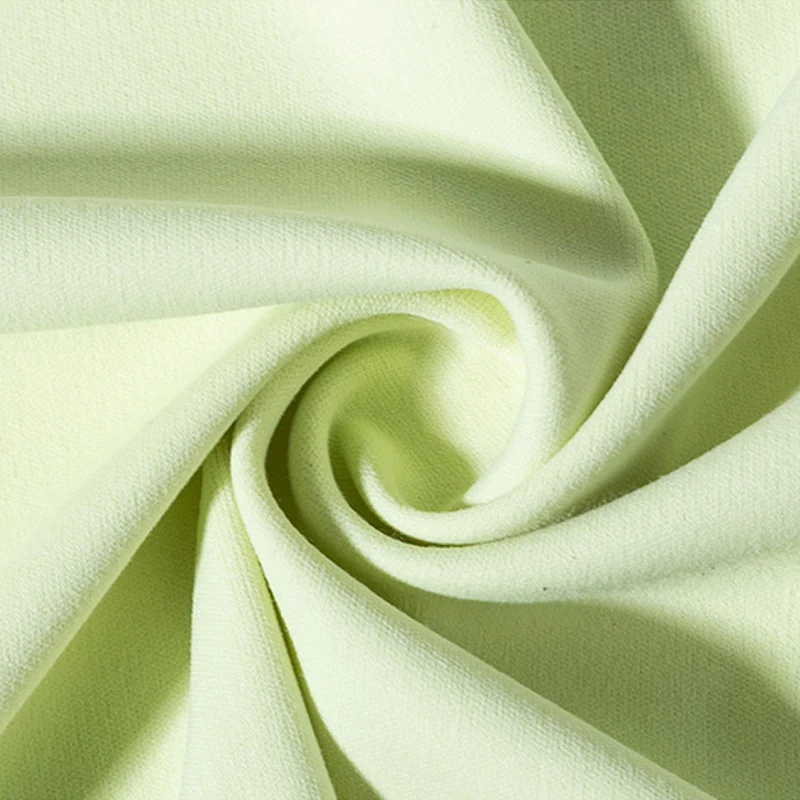
The Nylon-Spandex Skin-Friendly Sharkskin Fabric is the on-site cloth that matches that job. It is a fitness nylon-spandex knit.
Read it as cloth to price, rather than as a finished garment or a lab report. You price it when the wearer is next to the cloth and the style is sportswear, yoga wear, or fitness apparel.
The composition cell reads 80% nylon and 20% spandex.
The yarn cell reads 40D nylon and 20D spandex.
The weight cell reads 185 g/m².
Put those three lines in the price file. Eighty percent nylon is the face fiber discussed above.
Twenty percent spandex is the stretch partner, and it does not stand in for a moisture result. The yarn count tells you the filament scale the mill used.
The weight sits in the middle of a gym knit. It lands between a heavy fleece and a tissue-weight mesh.
| Cell | What the card prints |
|---|---|
| Product name | Nylon-Spandex Skin-Friendly Sharkskin Fabric |
| Composition | 80% Nylon, 20% Spandex |
| Yarn count | 40D Nylon / 20D Spandex |
| Weight | 185 g/m² |
| Specific usage | Sportswear, Yoga Wear, Fitness Apparel |
Skip this cloth when you need a printed moisture-transport result before you will sample, or when the real job is a cold insulating layer. A gym next-to-skin knit and a winter base are different sweat problems. This card is aimed at the first.
If the hand feels right and the end use matches, the honest next step is small. Send the five cells back with one added question: which liquid-moisture method was run, and what did it show? Until that answer arrives, you are pricing a fitness knit for a sweat job, not buying a proven wicking claim.
What still has to be asked before the cloth is called proven
Ask for a named liquid-moisture method such as AATCC TM195, because a heavy sweat load can still saturate a top.
AATCC TM195 is the published method for liquid moisture management of knitted, woven, and nonwoven fabrics. The public summary says the result depends on water resistance, repellency, absorption, the cloth’s structure, and the wicking characteristics of the fibers and yarns.
That is the family of facts a slogan skips. The store page summarizes the method and gives no lot score.
A heavy sweater can still soak a technical top. Runners describe temperature control, and they note that cotton can keep cooling you after you stop sweating.
They also say evaporation has to keep up. If sweat arrives faster than it can leave, the shirt saturates anyway.
Different tops that all claim the same story can still wring out differently. A dry finish is a further hope, not the job they describe.
So the question to the mill is specific. Was this lot checked with AATCC TM195 or another named liquid-moisture method?
What was recorded for movement from the skin side to the outer face? If the answer is that the test was never run, keep the knit in the price file as a nylon-spandex fitness cloth and keep the wicking word off the purchase order.
That ask is how you use the best sweat wicking fabric idea without pretending a card already proved it. The idea is the job.
The card is the construction. The method is the missing line.
FAQ
What fabric absorbs the most sweat?
Cotton and similar plant fibers take water into the fiber and hold it, which is why they feel heavy after a warm workout. Absorbing a lot of sweat is a different job from moving sweat to the face of a gym knit so it can leave.
Is it better to sweat in cotton or polyester?
Polyester is the better gym default when the goal is to move sweat instead of storing it in the fiber. Cotton can feel pleasant at the start and then stay wet and clammy, which is the behavior athletic cloth is trying to avoid.
Does sweat-wicking fabric really exist?
Yes. It is capillary movement of liquid sweat away from the skin toward the outer face, where evaporation can happen. A soaked shirt can still feel wet after a long, humid effort.
What kind of gym wear is best for sweaty people?
A next-to-skin nylon or polyester knit with a face that does not go slick and tight when wet is the practical gym choice. Pair that hand-feel with a named moisture result before you treat the cloth as proven.
Is spandex a sweat wicking material on its own?
No. Spandex is the stretch fiber in a gym knit, and the sportswear literature treats moisture movement as coming from the other fiber and from the fabric structure.
A 20% spandex share explains fit. It does not replace a moisture test.
What material is best for excessive sweating?
No fiber keeps a very heavy sweater dry if evaporation cannot keep up with the sweat rate. Choose a knit that moves liquid to the face, then judge it with a real session and a method result, not with the fiber name alone.
Why does one polyester shirt cling when another does not?
Face, density, and how open the knit is change cling even when both shirts are polyester. A smoother, tighter face sticks. A rougher or more open face can be soaked and still hang away from the skin.