



















































































































How Buyers Name the Cloth on a Tee Spec
The best type of t shirt fabric is a jersey knit whose fiber, yarn count, weight, width, and knit method match the tee being cut. Ranked pages mostly stop at cotton, polyester, or a blend. The sections below separate those fiber names from the rest of a cloth card, then show one modal knit a buyer can map onto a tee spec.
What a Tee Spec Is Asking For
A tee spec names a cloth, and a cloth is more than a fiber slogan. The buyer who writes “soft cotton tee” has named a feeling. The mill still needs the construction, the fiber line, the yarn, the weight, the width, and the way the loops were made.
Ask what is t-shirt fabric and the construction answer, in ordinary apparel cutting, is jersey. Ask what is t shirt fabric made of and you are on the fiber line only.
Both questions stay fair, and they still point at different lines.
| Spec line | What a slogan usually gives | What a cloth card should print |
|---|---|---|
| Construction | “Tee cloth” | Jersey or another named knit |
| Fiber | Cotton, modal, or a blend nickname | Each fiber and its share |
| Yarn | “Soft” or “ringspun” | The yarn count the mill ran |
| Weight | Light, mid, or heavy | The mass unit printed on the card |
| Width | Ignored | The cuttable width |
| Knit method | Ignored | Weft or another named method |
A slogan can start the conversation. It cannot replace the row a cutter uses. When a line is blank, the honest spec leaves it blank instead of inventing a grade.
Sewers already separate these ideas in plain language. One sewing thread noted that a tee shape can be cut from a woven, and that the pattern then has to be a woven pattern. The cloth and the garment outline are different decisions.
Jersey Is the Cloth Most Tees Use
Jersey is the knit most tee bodies use. CottonWorks describes it as the common knit in t-shirts, underwear, and swimwear, with a smooth face of wales and a back of crowns.
A single jersey feeds every needle through the basic knit cycle, so the face is one repeated stitch. That is the cloth people mean when they say a tee should feel like a tee.
Pique, fleece, and rib are relatives. They are different body cloths.
Jersey gives more across the width than along the length. CottonWorks puts that width stretch at about twice the length stretch.
The edge also curls, and a cut across the width can run. Those habits matter when a panel is narrow or when the marker sits close to the selvedge.
Related knits for this application sit on the underwear and t-shirt fabric category. The category is a browse of cloths. The browse does not replace one card’s yarn, weight, or width.
Trade pages sometimes call jersey a weave. The construction teachers call it a knit. Use the knit word on the spec so a woven poplin does not get pulled into the same cut.
Fiber Content Is Only One Line
The fiber line says what the yarn is made of, and US textile rules ask for the generic name once a fiber reaches 5% of the weight. English is the language of that required line. Spandex is the generic name those rules use for this stretch fiber.
Those rules define spandex as a manufactured fiber built from a long-chain synthetic polymer that is at least 85% segmented polyurethane. That sentence names the fiber. It does not print a stretch percent for any one cloth.
Cotton still dominates the pages that rank for this query. Combed cotton has had short fiber brushed out before spinning. Ring-spun cotton has been thinned and twisted into a finer strand.
A listing that says only “cotton” has skipped both of those steps.
Polyester shows up next, usually for shape hold, quicker drying, or a print method that likes a synthetic face. Rayon shows up inside tri-blend talk, where it is the fiber people credit for drape. Modal shows up as another name in that same market conversation.
Printify lists it beside linen and tri-blend, without a yarn count or a width.
One blank-shirt guide describes its CVC cloth as typically around 60% cotton and 40% polyester. That same guide describes a typical tri-blend as 50% cotton, 25% polyester, and 25% rayon.
Those ratios belong to that guide’s blanks. They show how a fiber line can look on a blank-shirt page.
From the field: Packers on a travel thread said maybe nothing is best, so pick the downside you can live with, because cotton dries slowly and polyester can feel like plastic r/onebag shirt-material thread.
A sewing comment praised cotton with spandex when the tee should look a little dressier. That is a fiber wish. It still needs a jersey, a yarn, and a weight before anyone can cut it.
Mood’s sewing notes put rayon jersey, plain cotton, poly-cotton, polyester, and spandex in separate paragraphs. The split is useful.
Spandex alone is a fiber name. It is the small second fiber sewers name when they want a dressier knit. This card does not print a stretch percent for that fiber.
Yarn Count and Weight Answer Different Questions
Yarn count and weight answer different questions, even when a listing jams them into one adjective. Yarn count talks about how fine the strand is. Weight talks about how much cloth you are holding.
Deluxe’s ringspun note says the higher singles number means a thinner yarn. Read that as a direction, not as a ranking of every count on the market.
A modal card that prints its own count is reporting the yarn it ran.
Blank-shirt sellers often switch the weight talk into ounces per square yard, or into a light, mid, and heavy band. That language describes a finished tee blank. A fabric card can use another unit.
Copy the unit the card prints. Leave the card’s unit as printed, even when a blank page talks in ounces.
On the modal cloth in the recommendation below, the yarn count cell reads 40S. The weight cell reads 170g/m.
Those two cells stay neighbors. Neither one is a softness score, and neither one is an ounce weight from a retail blank.
Hand feel still has a place in the conversation. Combed and ring-spun language exists because buyers can feel the difference in cotton jerseys. Keep that language on the cotton yarn it describes.
A modal line that does not say combed or ring-spun should not inherit those cotton words.
Width and Knit Method Change the Cut
Width tells the cutter how much cloth is in the roll, and the knit method tells how the loops were formed. A soft hand can come from a narrow cloth or a wide one. The marker only works when the width is known.
Jersey’s curl and its tendency to run from a cross cut both get more expensive when the width is tight for the pattern. A wider goods roll can change the number of bodies per lay. That is a cutting fact, separate from whether the fiber is cotton or modal.
The modal card’s width cell reads 175cm. Its yield cell reads 3.3m/kg.
Together they tell a buyer how the roll converts from weight to length at this width. They do not tell shade, finish, or how the cloth will be printed.
The knitting method cell reads Weft Knitting. That matches a jersey-type loop made course by course.
A sentence elsewhere on the same product page mentions warp-knitting machines. It conflicts with the table, so the spec follows the table.
Weft knitting is the method a tee body usually wants when the cloth is jersey. Rib trim, collars, and a woven label are separate components. Name them on their own lines if the garment needs them.
Choose a Modal Knit for a Soft Tee Spec
Choose this modal knit when the tee spec wants a soft weft-knit jersey and the buyer can copy the printed cells without filling blanks. The page for this 40S modal fabric is the cloth behind that choice.
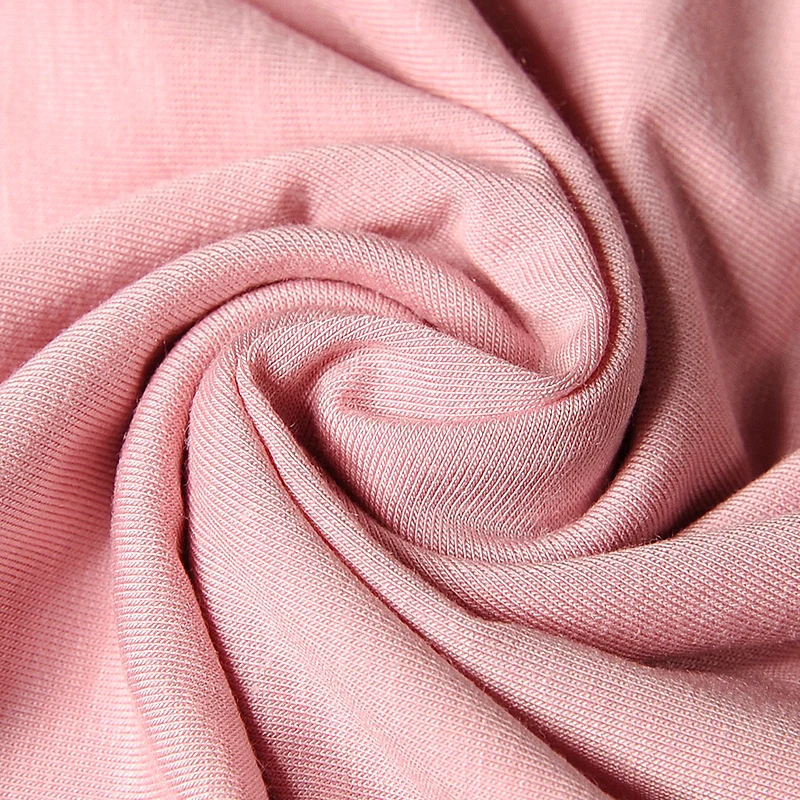
The product name cell reads 40S Modal Fabric. The composition cell reads 95% Modal, 5% Spandex.
A buyer maps this modal knit onto a tee spec. The table itself does not print the word T-shirt.
| Card line | Printed value |
|---|---|
| Product Name | 40S Modal Fabric |
| Composition | 95% Modal, 5% Spandex |
| Yarn Count | 40S |
| Weight | 170g/m |
| Width | 175cm |
| Kilogram/Meter Ratio | 3.3m/kg |
| Knitting Method | Weft Knitting |
Leave the card’s silent cells silent. It does not print a stretch percent, a colorfastness grade, or a sun-protection number. Inventing any of those would turn a real table into a guess.
Skip this cloth when the spec demands a fiber the table does not print, such as a cotton-only face or a polyester athletic face. Skip it when the program needs a number the table never gave. Another knit on the underwear and t-shirt category may fit that program better.
The modal and spandex line is still only the fiber line. Jersey, the 40S yarn, the 170g/m weight, the 175cm width, the 3.3m/kg yield, and weft knitting are what make the mapping specific. Copy them together, or do not claim the card says more than it says.
FAQ
What’s better, 100% polyester or 100% cotton?
Neither fiber wins every tee. Cotton is the usual breathable everyday face, and it dries slowly according to travelers. Polyester holds shape and dries faster, and some of those same travelers dislike the hand.
What material t-shirt is best for summer?
Hot, dry days with easy laundry are where cotton jerseys earn their place. Humid trips with sink washing push people toward linen or a quicker-drying synthetic. The season does not replace the yarn, weight, or width on the spec.
Is 100% cotton the best for shirts?
Cotton is the common answer on retail and print-shop pages. A dressier knit may add a little spandex. A performance shirt may leave cotton behind.
Name the job, then name the cloth.
What is considered a high-quality t-shirt?
On the pages that rank here, quality usually means a finer cotton yarn, such as combed or ring-spun, plus a jersey that still feels sound after washing. It is a process description. It is not a logo and not a single lab score.
Is 60% cotton 40% polyester good for summer?
That ratio is a cotton-rich blend of the kind one blank guide calls CVC. It keeps a cotton majority and uses polyester for shape. Summer comfort still depends on weight, fit, and whether the wearer is sitting in dry heat or humid air.
Why do people avoid polyester?
The travel thread’s complaint is odor and a plastic-like hand. Print shops still use polyester when they want durability or a print method that suits it. Avoiding it is a preference, and the spec should record the preference as a fiber line.