



















































































































Fabric Wicking Test: Methods and Moisture-Transport Report Checks
A fabric wicking test measures how liquid travels through a textile under a defined procedure. It can follow upward travel along a strip, spreading across a surface, or transfer between the two faces. These are different questions, so a single “moisture-wicking” label is not a complete specification. For a tops or mid-layer programme, choose the movement that matters, identify the finished fabric and direction, and compare samples under matching preparation and test conditions. Then check whether that evidence supports the intended garment claim after care.
This guide focuses on reading reports and preparing a useful purchasing brief. It does not assign a performance rating to an untested fabric or provide a substitute laboratory procedure. A development swatch can help identify the material to investigate; its appearance cannot reveal its wicking speed.
Choose the liquid movement you need to measure
Start with where the water is supplied and where you want it to go. In a vertical strip assessment, liquid moves upward against gravity. In a horizontal assessment, it spreads in the plane of the sample. For a next-to-skin fabric, you may also need evidence about movement from the inner face toward the outer face. A wide wet patch on the skin side does not, by itself, prove outward transfer.
NC State’s liquid-moisture testing overview describes vertical strip wicking alongside gravimetric absorbency and moisture-management measurements. These separate approaches help explain why two reports with different endpoints should not be ranked as though they measure the same property. Ask the laboratory to name the endpoint before discussing which sample performs better.
Keep the brief attached to the garment. A loose mid-layer and a close-fitting base layer can place different demands on fabric contact, liquid supply and drying opportunities. The test should answer a defined material question, while a garment trial checks the combined effect of fit, seams and layering. Neither assessment should silently replace the other.
Read the method title, edition and endpoint
The current public listing for AATCC TM197-2022 identifies vertical wicking to specified distances and states that the method applies to woven, knitted and nonwoven fabrics. Do not identify a method only by an old report heading or a shortened catalogue label. A method number without an edition and endpoint leaves room for an avoidable comparison error.
For example, “time to a defined distance” and “distance after a defined time” organise the observations differently. Before comparing results, ask which quantity is fixed, which is measured, and how incomplete travel is reported. A sample that does not reach the endpoint should not be assigned an invented completion time or omitted from a summary because it makes the chart less tidy.
Laboratories should use the full applicable procedure for specimen dimensions, liquid, conditioning and handling. Buyers need those details in the report, rather than an informal test assembled from a supplier video. Agree any departure in writing and identify the result as a modified method when appropriate.
| Report question | Evidence to request | Comparison boundary |
|---|---|---|
| How does liquid travel upward? | Vertical method, direction and stated endpoint | Match specimen preparation and endpoint |
| How does liquid spread across a face? | Horizontal assessment with face identified | Do not rank against vertical distance alone |
| Does liquid move away from the skin face? | Face-to-face transport assessment | Surface spreading alone does not answer this |
| Will the fabric dry promptly? | Separate drying assessment | Wicking is not an evaporation measurement |
The table is a test-selection aid, not a list of interchangeable procedures or universal pass limits. The appropriate combination depends on the intended claim and the laboratory’s agreed scope.
Lock the identity of the finished sample
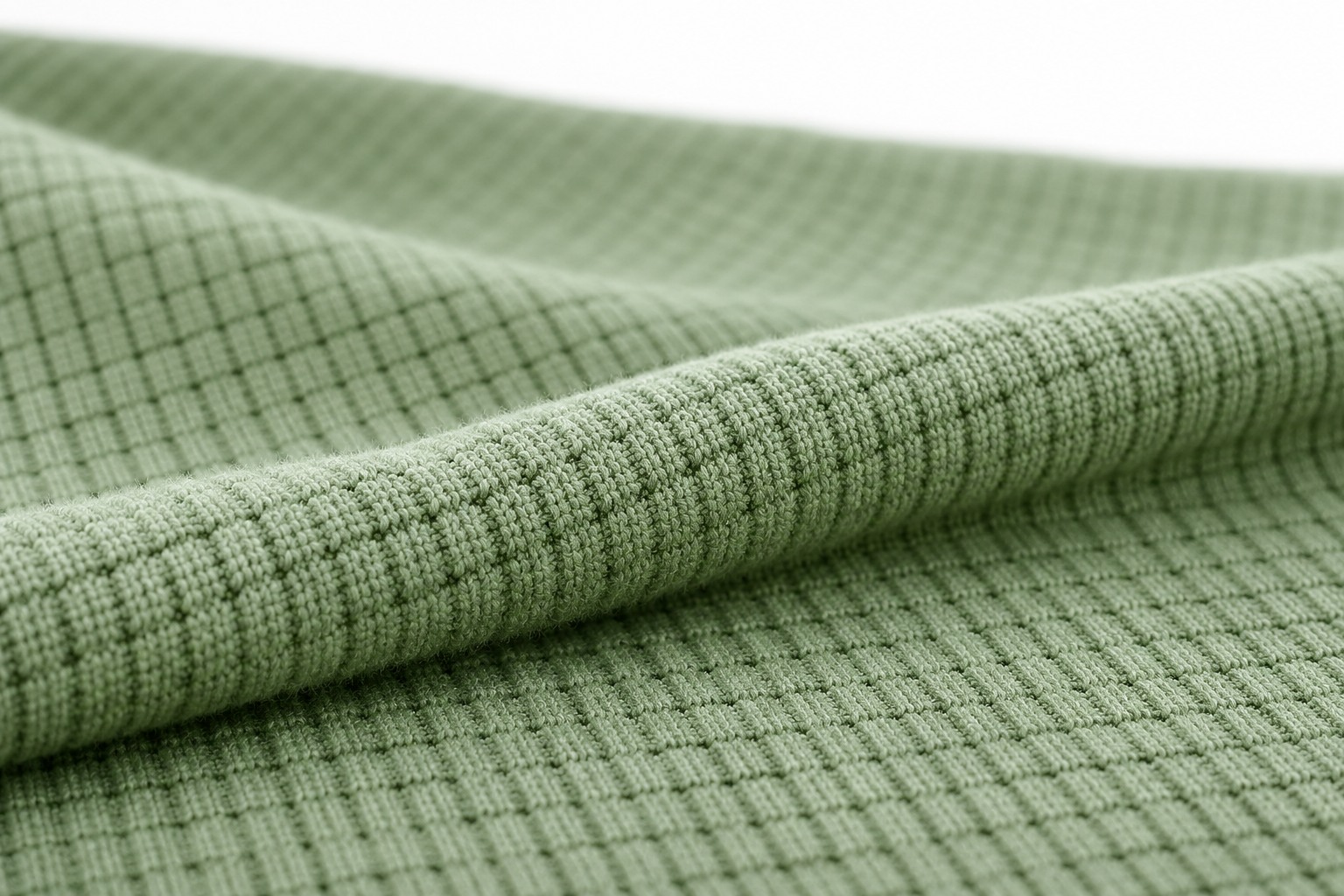
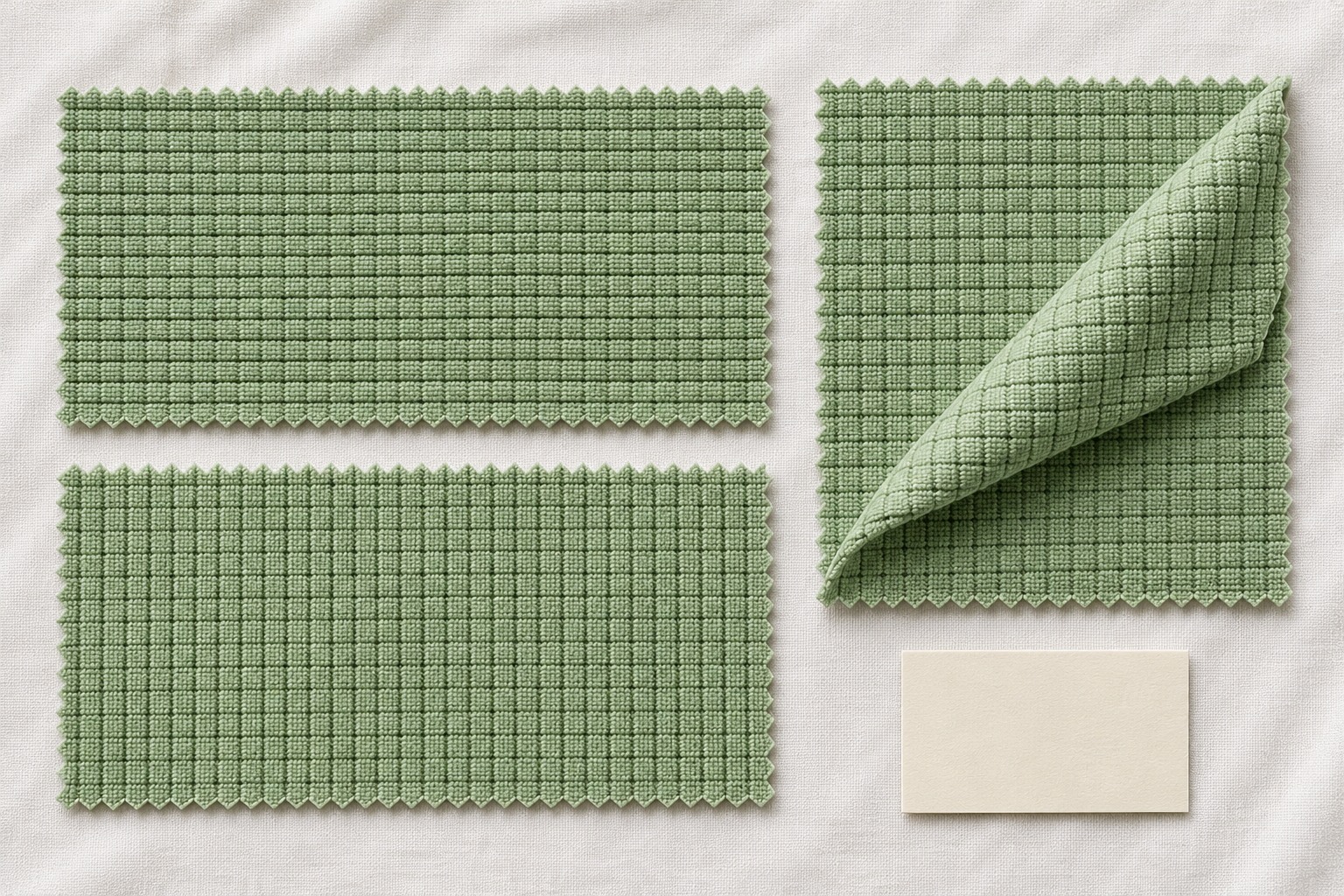
Record the fabric reference, colour, lot, construction, finish state and intended garment face. Mark the length and width directions before cutting. A small sample bag labelled only “polyester” cannot reliably connect a result to a bulk order. When the fabric has a visible grid or surface texture, use photographs to support identification, while retaining the physical specimen and its written reference.
Shengchao’s Moisture-Wicking Polyester Fabric listing provides a relevant starting point for a tops or mid-layer development. Its pale green grid-textured photograph identifies a particular product appearance. The page’s material description and application are useful for selecting a sample, but they do not establish a measured wicking rate, durability after washing, or a guaranteed comfort outcome for your garment.
Ask for the specific current sample rather than assuming every colour or finishing route is identical. If development changes the hand feel, dyeing process or finishing recipe, confirm whether the tested specimen still represents the new version. A report for the previous sample should stay attached to that previous identity until its applicability is reviewed.
Separate wetting, storage, transport and drying
A drop disappearing from the surface is an observation about wetting and uptake under those conditions. It does not reveal how far the liquid travels, which face holds it, or how quickly it eventually leaves. A fabric can distribute water over a large area while retaining substantial moisture. Another may take little liquid into the fibre itself but still transport water through spaces in its structure.
Use the broader wicking versus quick-dry guide to organise the performance brief. For a report that specifically addresses wetting, consult the separate fabric absorbency test guide. Keeping these questions separate makes it easier to request the missing evidence instead of assuming a strong result in one category covers every moisture-related claim.
A practical example is a training top intended to spread intermittent sweat. You might first compare liquid transport under one agreed procedure, then compare drying under another, using the separate fabric drying-rate report checks to define that evidence. If the wearer uses a backpack or an additional layer, include that garment context in subsequent development. Do not label the laboratory test a complete recreation of exercise or convert its output directly into a promised feeling of coolness.
Plan care comparisons before the first test
If a claim must remain meaningful after repeated care, include paired new and cared specimens in the original request. Specify the care route, detergent, number of cycles, drying approach and any restrictions that belong to the product. The number of cycles is a purchasing requirement to agree, not a universal value that can be borrowed from an unrelated fabric.
Keep preparation consistent between candidates. Comparing an untouched swatch with another that has already been washed, softened or heat-treated can confuse a material difference with a preparation difference. Ask the laboratory how conditioning and sample history are recorded. Where the test programme includes several stages, use distinct specimen codes so the after-care sample cannot be mistaken for its unwashed partner.
Retain an approved control if the programme needs continuing comparisons. Run it under the same conditions as later lots and review unusual changes with the laboratory. A retained swatch is a reference for investigation; it is not permission to skip representative bulk sampling or to claim that every future delivery has already passed.
Interpret an uneven wet front carefully
Textile surfaces do not always show one sharp liquid boundary. Different local paths, colour contrast and texture can make a front difficult to observe. Ask how the laboratory identifies the wet front and handles irregular movement under the selected procedure. Do not choose the highest visible point yourself and call that the result without knowing the reporting rule.
Look at individual observations as well as the summary when investigating an unexpected difference. Directional variation, specimen handling or an isolated local effect may be hidden by one average. Request the laboratory’s explanation and any appropriate repeat work before changing an order specification. Repeating only the best-looking sample until it passes would weaken the meaning of the approval.
Also distinguish a development screen from a release decision. A quick in-house comparison may help decide which samples merit formal testing. If it changes the liquid, geometry or observation method, record that fact and avoid presenting it as an accredited result from a named standard.
Watch the capillary principle, then write the inquiry
Khan Academy’s lesson explains cohesion, adhesion and capillary action, including upward movement in a fibrous material. It provides useful background for understanding why liquid can move through small spaces. It does not demonstrate AATCC TM197 or establish a wicking result for the product shown in this article.

A useful request could read: “Please identify the proposed tops fabric and both faces, recommend a suitable vertical or face-to-face transport assessment for our claim, and quote paired new and cared samples. State the method edition, endpoint, directions, preparation, individual observations and reporting limitations. We will agree the acceptance requirement before bulk approval.”
Attach the garment application and expected care instructions. Include the planned colours, finish state, sampling quantity and required decision date. Ask who will retain the reference specimen and how the tested sample code will appear on the order records. This makes the result usable when the development team, laboratory and purchasing team review it at different times.
Approve the claim only to the extent supported by the final evidence. A traceable wicking report can support a defined transport statement. Drying, water-vapour resistance, skin contact and whole-garment comfort may need additional checks. Keep the report and the wording together so a concise marketing description does not gradually become broader than the tests behind it.
Frequently asked questions
Does a fast water-drop disappearance prove good wicking?
No. It shows a wetting or uptake observation under that drop test. Wicking requires a defined assessment of liquid movement, with direction and endpoint identified.
Can I compare horizontal spreading with vertical travel?
They answer different questions. Compare like-for-like procedures, and use complementary assessments when both movements matter to the garment.
Does a polyester composition guarantee a wicking result?
No. Fibre identity alone does not establish the behaviour of the finished textile. Request evidence for the actual construction, finish, colour and care state.
Should the report identify the face touching the skin?
Yes, when face orientation matters to the claim or procedure. Record the intended inner and outer faces and avoid reversing them between sampling, testing and garment development.