

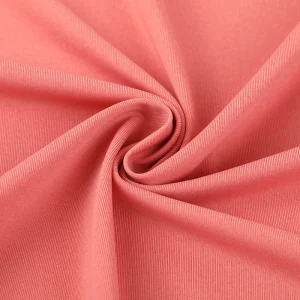
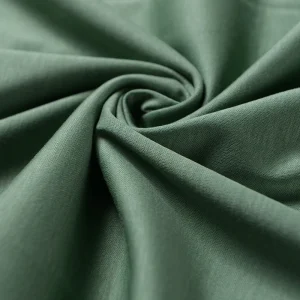



What Is Sportswear Fabric? A Clear Buyer Definition
Sportswear fabric is the performance cloth used to build active apparel so garments can stretch with the body and manage sweat better than ordinary fashion fabric. If you are asking what is sportswear fabric, start with the jobs the cloth must do, then look at fibers, knit structure, and the fields on a mill card. This piece clears common myths about fiber shopping lists and “best fabric” rankings, then walks one published 40D nylon-spandex example.

What Sportswear Fabric Actually Means
Sportswear fabric is performance apparel cloth specified for movement and sweat management, not ordinary fashion cloth alone.
In mill and brand language, the phrase points to textiles chosen for active garments — running tops, training shorts, yoga pants, sports bras, and similar pieces. The same fiber names can appear in fashion apparel.
The difference is the performance job list attached to the cloth: stretch behavior, moisture handling, and constructions that stay workable during activity.
Treat “sportswear fabric” and “activewear fabric” as near synonyms in most procurement buyer conversations. Both signal performance apparel cloth rather than a single trademarked fiber.
Outdoor membrane shells sit in a related category. They are not the center of this definition, and they are not what most yoga or gym knit cards publish.
The Jobs Sportswear Fabric Is Asked to Do
The cloth is expected to move with the body and help manage moisture so the wearer stays workable in activity.
Three jobs show up again and again in education sources and retail FAQs:
- Movement — stretch that follows bends, twists, and reaches, often described as two-way or four-way stretch for multi-direction garments.
- Moisture management — moving sweat toward the outer surface so it can evaporate instead of sitting against skin like a wet sponge.
- Wearable durability for the program — surviving repeated wash and wear cycles without collapsing into a fashion-only handfeel story.
Moisture-wicking is the common name for that second job. Chemistry explainers describe it as capillary transport through engineered yarns and spaces, not magic dryness.
A fiber that soaks and holds water fights the job. A fiber that sheds every drop without pathways also fails. Good sportswear fabrics sit in the middle: enough attraction to move liquid, enough structure to spread it for drying.

Tip: When a teammate asks only for “more stretch” or “more wicking,” ask which garment and which wash routine. Those jobs compete with opacity, support, and handfeel, and the card fields after fiber content usually decide the trade. (ACS moisture-wicking explainer; archived r/BuyItForLife fabric guide)
What Sportswear Is Made Of
Most sportswear fabrics use polyester or nylon bases with spandex; cotton is a weak default for hard sweat sessions.
What is sportswear made of in practice? Synthetic bases dominate high-sweat and close-fit programs.
Polyester shows up widely for light weight, durability, and moisture-management constructions. Nylon is valued for strength, a smooth hand, and abrasion resistance in high-wear bottoms and support pieces.
Spandex is the stretch filament blended in — you will not see a practical 100% spandex sportswear shell.
Natural and cellulosic options still appear. Merino wool and man-made cellulosics (such as lyocell families) show up in base layers and lower-impact athleisure.
Cotton remains soft for lifestyle pieces, but it holds a lot of moisture. ACS education materials list cotton moisture regain near 8.5%, nylon near 4%, and polyester near 0.4%, which helps explain why cotton feels wet longer in hard sessions.
| Fiber role | What buyers usually want it for | What it does not guarantee alone |
|---|---|---|
| Polyester | Durable, often quick-drying bases for tops and team knits | Softness, opacity, or a specific compression level |
| Nylon | Smooth, abrasion-resistant close-fit bottoms and bras | Automatic “cooler” comfort without construction checks |
| Spandex | Stretch and return in blends | Moisture management or durability by itself |
| Cotton | Soft low-sweat or lifestyle blends | Hard-workout dryness |
Spandex percentages vary by garment. Some commercial primers cite mid-single-digit to low-double-digit bands for many activewear blends, while close-fit bottoms can run higher. Treat any band as a starting conversation, not a quality score.
Why Knits Show Up So Often in Sportswear
Close-fit sportswear often uses knits because they stretch more readily than many woven structures.
Reviews of sports textiles repeatedly note that knitted fabrics are preferred for many active base garments because of elasticity and freedom of movement compared with many woven cloths.
Open knit constructions can also leave more room for air and vapor to move. When a garment fits loosely, openness of construction can matter as much as fiber name.
When the fit is snug, fiber content and yarn choices become more critical.
That does not ban woven sportswear. Softshells, some outer layers, and structured pieces use woven or laminated builds.
For leggings, bras, and many training tops, though, buyers should expect knit language on the card — jersey, interlock, double-sided knit, tricot, and similar process names.
How to Read a Sportswear Fabric Card
Fiber percentages are ingredients; yarn count, knit process, width, and weight change how the cloth behaves.
Two cards can both say “nylon/spandex” and feel nothing alike. Independent blend explainers make the same point: composition describes ingredients, not finished performance.
Yarn size, filament structure, knitting method, fabric weight, stretch direction, heat setting, dyeing, and finishing all move the result.
Read at least these fields together:
- Composition — which fibers, and roughly how much stretch filament is present.
- Knitting process / construction — single jersey, double-sided, mesh, and so on.
- Yarn count — denier or count labels that hint at yarn fineness.
- Width — cutting yield for the pattern set.
- Fabric weight (g/m²) — how heavy the cloth sits for the silhouette.
From the field: Home sewists and fabric-forum buyers often learn the hard way that nylon-versus-polyester ratios alone do not predict pilling or hand. Weight, knit, and finish create large gaps between cards that share the same fiber story. (archived r/BuyItForLife fabric guide)
Choose This 40D Nylon Double-Knit When Close-Fit Stretch Leads
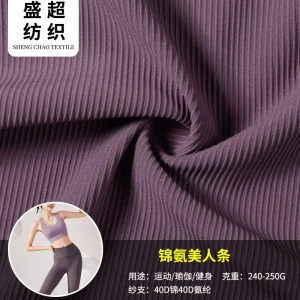
One published Shengchao card shows a nylon-spandex double knit with listed yarn count, width, and weight.
After the category definition, it helps to see a real published table rather than another abstract fiber list. Shengchao’s 40D nylon double-knit high elastic fabric sits in the sportswear and yoga lane.
The published card lists 75% nylon and 25% spandex, a double-sided knit, a yarn count of 40D, a width of 160 cm, and a weight of 230 g/m².
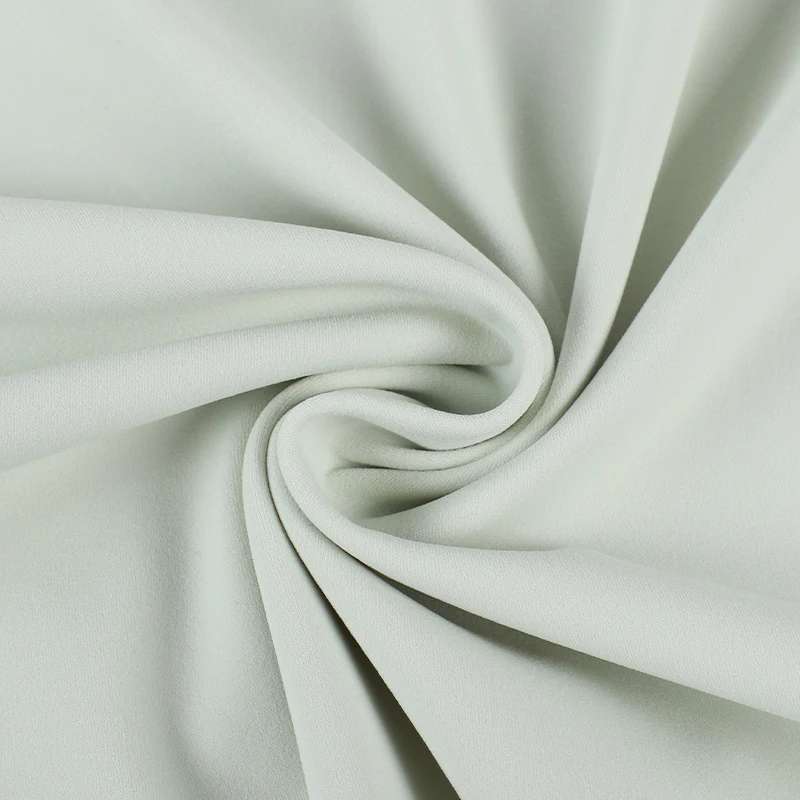
Published specification fields appear in the table below.
| Published field | Value on the card |
|---|---|
| Composition | 75% Nylon, 25% Spandex |
| Knitting process | Double-sided |
| Yarn count | 40D |
| Width | 160 cm |
| Weight | 230 g/m² |
| Applications (as published) | Yoga pants, leggings, bras, sportswear, casual pants, skinny pants, and similar |
Use this card when you need a nylon-rich stretch knit reference for close-fit bottoms or bras. It is a poor match if your program needs a polyester-dominant jersey print story, a woven outer shell, or a certified waterproof membrane — those jobs are outside what this table publishes.
Marketing lines on the product page about elasticity or moisture-wicking are published claims, not third-party lab certificates.
Hub context for related styles: Sportswear & Yoga Fabric.
What “Best Fabric for Sportswear” Really Means
There is no universal best fabric — match the garment job and the card fields.
Search pages keep asking what is the best fabric for sportswear. The useful answer is literacy, not a ranking invent.
Polyester may win a running-jersey conversation. Nylon-spandex may win a yoga-legging conversation. Merino may win a cold multi-day base-layer conversation.
Cotton blends may win a low-sweat lifestyle tee conversation.
Ask three questions before anyone crowns a winner:
- What garment and activity intensity?
- What fit — loose, close, or compressive?
- Which card fields are non-negotiable (weight band, stretch direction, opacity targets, wash routine)?
Community threads on activewear materials make the same caution: fiber percentages have a limited effect compared with weight, construction, and finishes. That is why “best” without a garment brief usually wastes sampling money.
FAQ
What is sportswear fabric?
It is performance apparel cloth chosen for active garments so the textile can support movement and moisture management better than ordinary fashion cloth alone.
What is sportswear made of?
Most programs use polyester or nylon bases blended with spandex. Merino, cellulosics, and cotton blends appear too, especially outside high-sweat or close-fit pieces.
What is the best fabric for sportswear?
There is no single winner. Match fiber, knit, and weight to the garment job — running jersey, yoga bottom, bra, or lifestyle tee each pull different cards.
Why is cotton a weak default for hard workouts?
Cotton holds moisture and dries slowly compared with common polyester and nylon sportswear constructions, so it can feel heavy and clammy in high-sweat sessions.
Does the fiber percentage tell me everything I need?
No. Yarn count, knit process, width, weight, stretch direction, and finishing change handfeel and behavior even when composition looks similar.
What does moisture-wicking mean on a sportswear fabric?
It means the cloth is designed to move sweat toward the outer surface so evaporation can happen faster than if liquid sat against the skin.
Is an all-polyester shirt the same as Dri-Fit?
No. Dri-Fit is a brand system. Many wicking shirts are polyester-based, but a generic all-polyester card is not automatically the same trademarked construction.
How should I read a card like the 40D nylon double-knit example?
Read composition, knit process, yarn count, width, and weight together, then check published applications. Use the published Path① table in the recommendation section as the numeric reference for that SKU.
References
- Don’t Sweat It: How Moisture-Wicking Fabrics Keep You Cool and Dry — ACS inChemistry. Moisture regain examples and capillary wicking literacy.
- A guide to activewear fabrics — Seamwork. Cotton caution for intense activity; Lycra as a spandex trademark.
- Sportswear: Acumen of Raw Materials, Designing, Innovative and Sustainable Concepts — IntechOpen. Fiber, yarn, and fabric variables that shape comfort.
- Sportswear overview (archived) — ScienceDirect Topics via Internet Archive. Sportswear comfort, moisture management, and stretch behavior.
- Clothing Fabric Help Guide (archived) — Reddit r/BuyItForLife via Wayback. User language on nylon drying, polyester durability, and spandex lifespan.