



















































































































Polyester vs Viscose Lining: How to Choose for Your Garment
For polyester vs viscose lining, compare the finished lining and the complete garment rather than choosing from fiber names alone. Polyester is commonly considered for wrinkle resistance and convenient care; conventional viscose rayon is commonly considered for absorbency, drape, and a different next-to-skin feel. Neither is automatically the best lining. Weight, construction, finish, stretch, seam behavior, and compatibility with the shell can change the decision. Begin with the garment’s intended use and care, then approve a representative sewn sample.
This guide helps apparel buyers compare the two families, identify the evidence missing from a product card, and write a practical lining request without confusing lining with interfacing or underlining.
First, identify the job the lining must do
A lining is an inner garment layer. It can help the garment slide over other clothing, cover internal construction, influence coverage, and contribute to the wearing experience. Those jobs differ from adding stiffness with interfacing or supporting a shell with an underlining. Decide which function is actually required before selecting the material.
New Mexico State University’s lining guidance emphasizes selection around the garment and compatible care. For a commercial brief, translate that principle into specific questions: Is this a sleeve lining over a shirt, a dress lining against skin, or a lining attached to a stretch shell?
A smooth sleeve lining and a close-fitting dress lining may need different balances. Assess how the candidate behaves with the intended shell and clothing underneath. Avoid using “premium lining” as the only requirement; the supplier still needs to know the weight, surface, movement, coverage, and care expectations.
Polyester and viscose: useful tendencies, not guarantees
Polyester lining
Polyester is a manufactured synthetic fiber. It is widely used in linings and can be made into different surface effects and constructions. A polyester lining might be smooth, textured, matte, lustrous, plain woven, or patterned; the composition line does not settle those choices.
The University of Georgia’s fiber and care reference identifies wrinkle resistance and wash-wear performance among polyester’s characteristics, while noting limitations such as static and sensitivity to excessive heat. These are fiber-level tendencies. Confirm the care and performance of the finished lining and assembled garment.
Viscose lining
Viscose is a type of regenerated-cellulose rayon. Do not assume that every textile labeled rayon has identical properties or that viscose, lyocell, and modal are interchangeable terms. If a quotation says only “rayon,” ask the supplier to identify the fiber type and full composition.
Conventional rayon is associated with absorbency, but can wrinkle and need careful handling when wet. Finishing and construction influence the outcome. UGA’s reference is useful background for those limitations; it does not authorize a universal washing instruction for every viscose lining.
Compare by the decision you need to make
| Buying question | Polyester direction | Viscose direction | What to check on the sample |
|---|---|---|---|
| Care priority | Often considered for convenient care and wrinkle resistance | May require more careful handling depending on the finished material | Compatible care for shell, lining, trims, and seams |
| Moisture and feel | Do not infer comfort from a smooth or shiny surface | Absorbency may be relevant for a next-to-skin brief | Wear assessment in the intended garment and climate |
| Drape and bulk | Depends on yarn, construction, weight, and finish | Depends on yarn, construction, weight, and finish | Hang and movement with the actual shell |
| Stretch compatibility | Composition alone does not establish extension or recovery | Composition alone does not establish extension or recovery | Both directions and the complete sewn assembly |
| Surface appearance | Available in many weave and finish effects | Available in different construction and finish effects | Show-through, shade, snagging, and seam appearance |
| Commercial approval | No automatic quality ranking from fiber name | No automatic quality ranking from fiber name | Written specification, benchmark, and relevant reports |
The fiber tendencies are grounded in the university references above. The sample checks are a purchasing framework, not claims that either family will pass a particular test or fit every garment.
Match the lining’s care to the whole garment
A lining that tolerates one cleaning route is not automatically suitable when the shell or another component requires a different route. Check the assembled garment’s care plan before final approval. Do not take a generic online statement that polyester is washable or viscose requires dry cleaning as the complete instruction for your product.
Ask for dimensional-change information under the intended treatment. A shell and lining that change by different amounts can produce an unsatisfactory garment even if each material seems acceptable alone. Assess the direction of change and the pattern allowances rather than relying on one overall “low shrinkage” description.
Include pressing and production processing in the review. Confirm suitable conditions with the fabric and garment suppliers, then trial the actual assembly. A change in surface gloss, seam appearance, or hand after processing can matter to the finished product even where the composition stays the same.
Comfort is more than fiber absorbency
Absorbency is relevant to some lining decisions, but it is not a complete comfort score. Garment fit, layer arrangement, thickness, surface contact, climate, and activity all affect the wearing experience. A tight lining can restrict movement even if the fiber sounds attractive in a comparison chart.
For a dress worn directly against skin, evaluate the proposed lining in a representative prototype. For a jacket worn over shirts, evaluate sleeve slip, movement, and how the lining interacts with the underlying garment. Keep wearer observations separate from measured laboratory results, and avoid turning a small internal preference trial into a broad performance claim.
Also confirm whether the lining is meant to contribute opacity. Review the intended colors and shell under relevant lighting and movement. A thin lining that feels pleasant on a swatch card may not provide the coverage or appearance required in the final garment.
A real polyester lining example from Shengchao
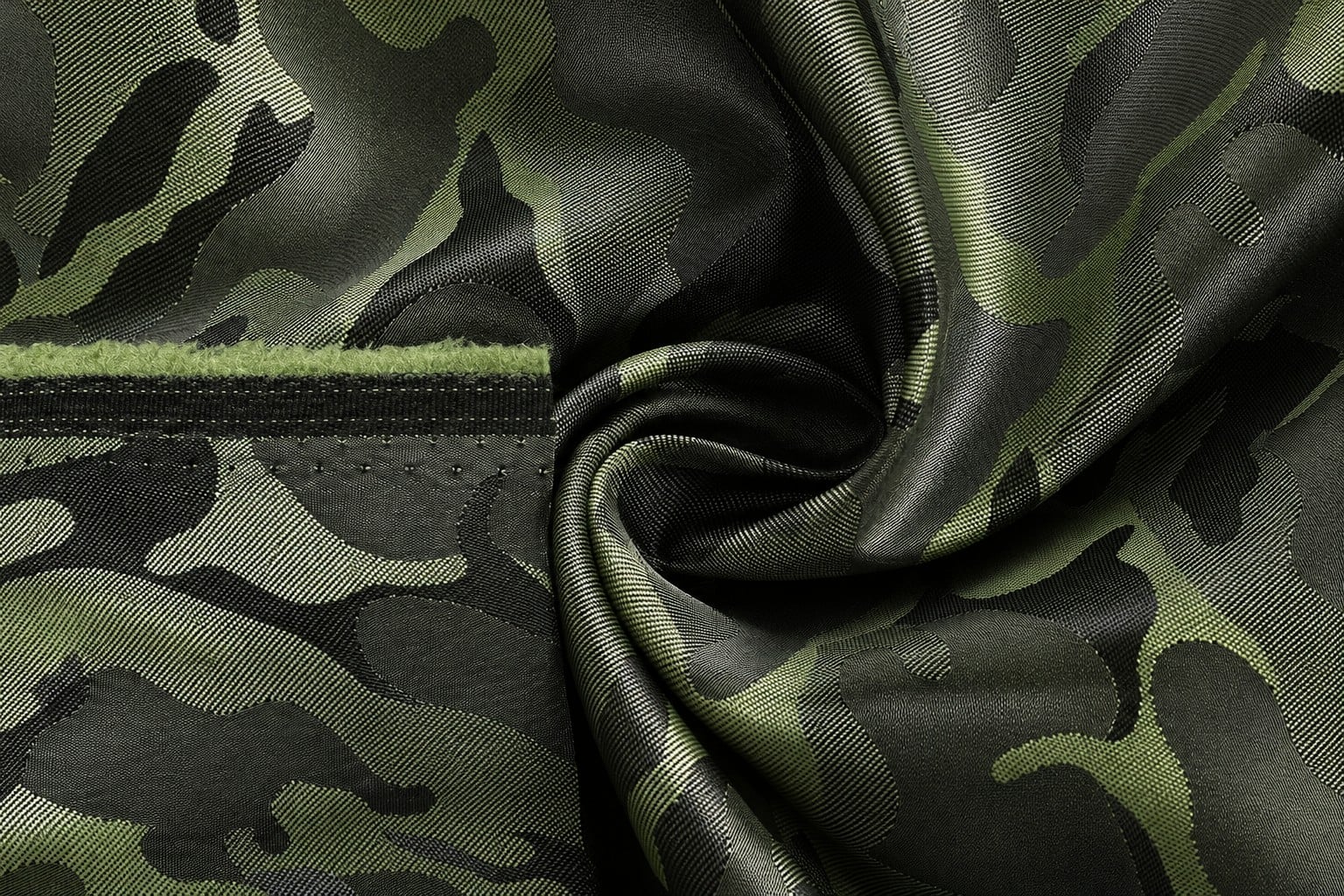
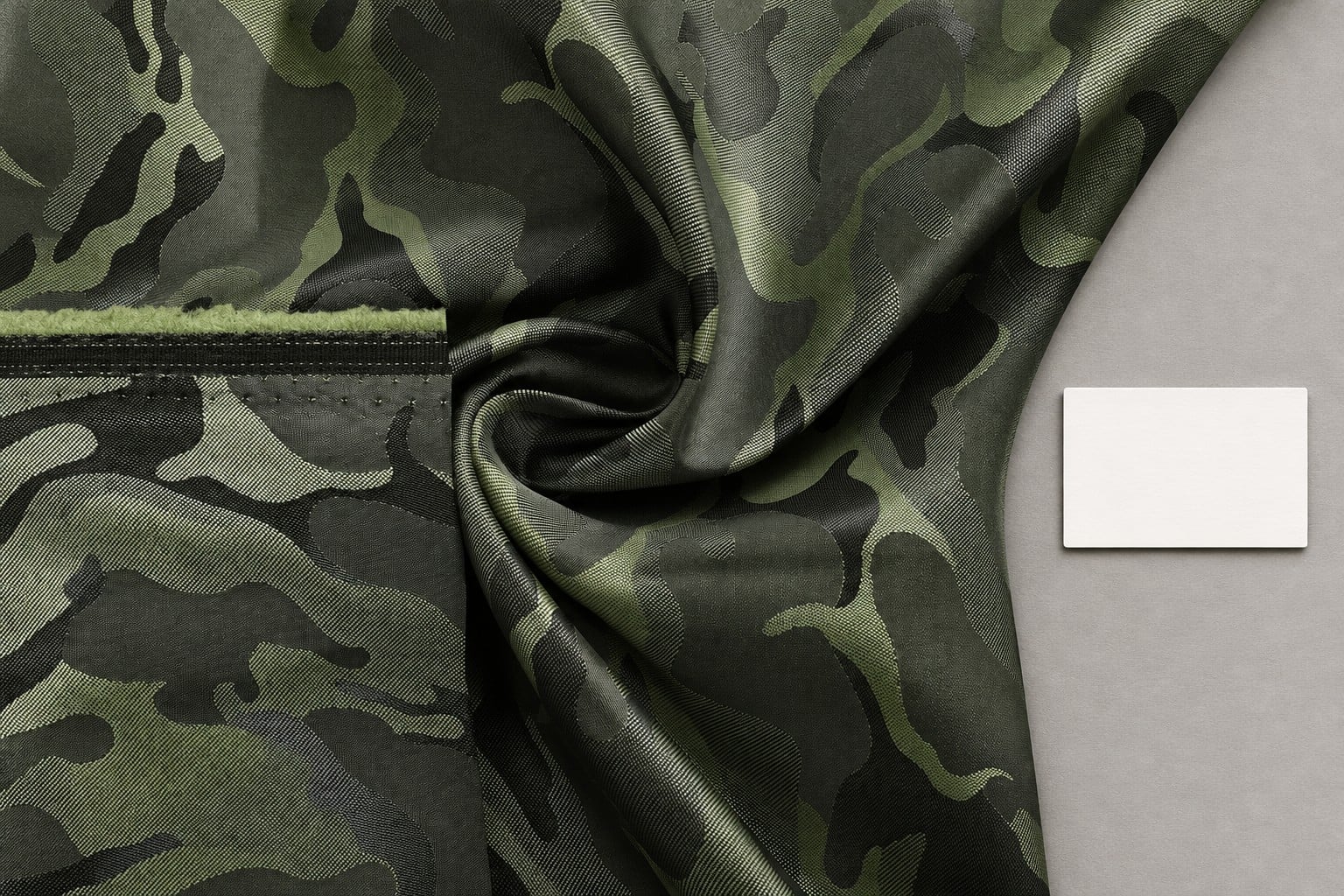
Shengchao’s jacket lining fabric, SKU TLLB-06, is listed as 100% polyester with a fine woven jacquard construction, 68D × 75D yarn count, 150 cm width, and 80 g/m² weight. Its current product photograph shows a green and dark patterned surface. The illustrations in this article use that polyester product photograph as their reference.
Those details identify one polyester candidate. They do not establish a viscose equivalent, a measured moisture-performance result, or a guaranteed level of abrasion resistance. Request a current physical sample and any required reports before using the material for a specific jacket program.
If you want a viscose alternative, ask for an independently identified viscose sample with its own composition, construction, width, weight, finish, and care information. Do not compare an unknown viscose cutting with the polyester card as though fiber type were the only variable. Match the other relevant parameters where possible, or record the differences explicitly.
Check movement and seams before deciding
For a stretch shell, the lining must allow the intended movement or be accommodated by the pattern and assembly. A lining with insufficient extension can become the limiting layer. Conversely, a very extensible lining can still behave poorly if its recovery, weight, or attachment does not suit the garment.
Confirm extension in both principal directions and coordinate orientation with the patternmaker. Review arm movement, sitting, bending, and the actual garment openings. Do not assume that a label such as satin, jacquard, or stretch tells you the measured response.
Make a sewing trial using production-representative thread, needles, stitch settings, and seam construction. Observe puckering, yarn movement at seams, snagging, and the appearance of the join after handling and the intended care. A lining that looks excellent as a flat swatch can reveal different issues when cut and sewn.
A controlled sample-comparison workflow
Start from an approved garment or a clear problem
Explain whether the current issue is static, sticking, excess bulk, poor drape, uncomfortable contact, seam distortion, or care mismatch. Supply a benchmark where possible. A precise problem statement makes the comparison more useful than asking for “better than polyester” or “luxury viscose.”
Keep each material traceable
Label the article code, supplier, lot, color, composition, construction, finish, weight, and width. Retain a reference cutting. If a supplier changes the finishing recipe or base construction during development, decide whether the comparison needs repeating.
Use the intended shell and care routine
Compare the candidates in the garment, not only in separate swatches. Use the intended shell, trims, and assembly. Agree any required assessments for dimensional stability, color transfer, seam behavior, or other program-specific requirements before bulk approval.
Record technical and commercial decisions together
Document the approved article, care conditions, appearance benchmark, test requirements, and acceptance limits. Compare usable width and actual consumption alongside price. A lower price per meter is not necessarily a lower finished-garment cost if it creates extra handling, changes the marker, or requires rework.
Watch how textile chemistry relates to care
ACS Reactions’ “Why Do Clothes Shrink in the Wash?” explains why fabric and care decisions require more than a simple fiber label. It is general educational background for the care discussion, not a polyester-versus-viscose test or an assessment of the Shengchao lining shown here.

Watch the textile-care explanation on YouTube.
Build the rest of the lining brief
Our lining selection guide provides the broader garment context, while lining fabric types covers the wider shortlist. Use the fabric shrinkage guide to interpret dimensional-change reports and the GSM guide to compare weight and consumption.
When requesting samples, send the shell reference, garment type, intended care, desired feel, target weight, movement requirements, and the main problem to solve through Shengchao Textile’s contact page. This supports a comparison of actual suitable materials rather than an unsupported ranking of fiber names.
Frequently asked questions
Is viscose lining always better than polyester?
No. The appropriate choice depends on the garment, finished fabric, care, movement, and wearer requirements. Compare representative sewn samples.
Does polyester lining always feel hot or uncomfortable?
No. Fiber content alone does not determine the complete wearing experience. Construction, weight, fit, layering, and environment also matter.
Can a viscose lining be washed?
Some finished materials may support washing, but do not assume a universal care route. Confirm the supplier’s evidence and the complete garment’s care requirements.
Are the product images in this article viscose?
No. They are based on Shengchao’s current 100% polyester jacquard jacket-lining photograph. A viscose alternative needs its own identified sample and specification.