



















































































































Colorfastness to Washing: Reports and Uniform Buying Checks
Colorfastness to washing is a textile’s resistance to colour change and colour transfer during a specified laundering exposure. A useful report separates change in the original fabric from staining of adjacent materials, and identifies the method and test option used. For school uniform buyers, a statement such as non-fading is not enough to approve a colour: the washing conditions, shade, lot and assembled garment all matter. Agree the intended care process first, obtain results for representative fabric, and review both appearance retention and staining before ordering bulk material. A washing result does not replace checks for rubbing, light exposure or dimensional change.
Read colour change and staining separately
Colour change concerns the tested specimen itself: after the prescribed treatment it may differ from its original shade or appearance. Staining concerns colour transferred onto an adjacent material during the test. These are related but separate outcomes. A fabric may retain an apparently strong colour while transferring enough colour to affect a pale component, so one combined comment cannot replace the individual assessments.
Ask for the complete report rather than a cropped image showing only a passing number. Identify which result applies to colour change and which applies to each adjacent fabric component. Keep the assessment method and reference conditions with the results. If the report contains a borderline grade, agree its treatment explicitly instead of rounding it to a more favourable whole number in a purchasing spreadsheet.
Match the standard and test option to the care brief
AATCC TM61’s published scope describes accelerated laundering tests intended to assess textiles expected to undergo frequent laundering. Its short controlled exposure is an approximation under prescribed conditions, not a guarantee of an exact number of real household washes for every garment. Check the option, detergent, bleaching conditions and other required details with the laboratory.
The National Textile University colourfastness testing list treats laundering, crocking, perspiration and light as separate test areas. This distinction is useful when building a uniform specification. Do not assume that a wash-fastness report establishes resistance to every exposure, or that a method number without its applicable conditions is enough to compare suppliers.
ISO 105-C06 is another commonly referenced laundering-fastness method. Where a customer requests it, confirm the precise option and edition instead of treating it as automatically interchangeable with AATCC TM61. A laboratory should work from the agreed method text. This buying guide does not supply a substitute recipe for operating equipment or calculating an accelerated test exposure.
Build a report checklist that prevents false comparisons
| Field to verify | Why it matters | Action when missing |
|---|---|---|
| Material, colour and lot identity | Connects the result to the proposed order | Request traceable specimen identification |
| Method, edition and test option | Defines the exposure being assessed | Ask the laboratory to state the complete reference |
| Detergent and bleaching conditions | Helps determine whether reports are comparable | Confirm conditions against the buyer’s requirement |
| Colour change result | Describes the tested fabric’s change | Do not replace it with a staining result |
| Staining results by adjacent component | Shows transfer to the assessed materials | Obtain the full result table |
| Pre-treatment and sample condition | Distinguishes an original sample from a treated one | Clarify treatment history before approval |
| Acceptance requirement | Separates measurement from the buying decision | Agree the relevant customer criterion before release |
The checklist is a procurement control, not a set of universal pass grades. Two reports with the same headline rating can still represent different conditions. Resolve those differences before using the numbers to rank materials. A more severe or simply different option may change the outcome without indicating an inconsistency in either laboratory’s work.
Start from the exact uniform fabric and shade
Shengchao’s school uniform fabric product page can serve as a starting reference for a sampling enquiry. Ask for the current available construction, colour and finishing details, then identify the physical sample that will be tested. The product page or a bright fabric photograph does not provide a measured wash-fastness grade for the material in your order.
Approve colours individually under an agreed programme rather than assuming that one tested shade represents every colour. Keep the dye lot and finishing state in the record. If the selected uniform includes contrast panels, embroidery, badges or pale trims, identify them during development. Their interaction in the assembled garment may need checks beyond the standard adjacent fabric used in a fabric-level test.
The broader uniform fabric guide helps frame the full purchasing decision. Washing appearance is one part of serviceability alongside fit, comfort, seams and care. Specify what the uniform is expected to do and how it will be maintained before turning those expectations into a laboratory request. A general preference for durability does not define a usable test condition.
Use representative samples and retain comparisons
Send enough material for the chosen test and any agreed repeat work. Ask the laboratory about sampling and preparation rather than cutting only a decorative swatch. Mark the material reference away from the assessment area, and retain an untreated comparison from the same sample. Record whether the sample comes from development, a lab dip, pilot production or the actual bulk lot.
A successful development test does not automatically describe a later production lot whose shade or finish has changed. Define when fresh evidence is required, especially after changes to colour formulation, processing or approved material. Retest according to the agreed quality plan rather than applying an arbitrary frequency. Traceable sample identity is essential when a later complaint needs to be compared with the original approval.
Keep laundering claims within the evidence
An accelerated laboratory test controls selected influences so that materials can be assessed consistently. Household laundering varies with wash load, detergent, water, programme, mixing of colours and drying practice. Do not convert a laboratory result into claims such as permanently colourfast or guaranteed unchanged after a season of use. The evidence applies to the tested specimen and the reported conditions.
Care instructions should follow the complete garment evaluation and the applicable customer requirements. A fabric that meets one laundering-fastness requirement may still need separate checks for dimensional change, print appearance, seam behaviour or trim performance. If the intended maintenance process involves industrial laundering or a different bleaching exposure, ask whether the selected method is appropriate before relying on a household-oriented test.
Check the assembled uniform before bulk release
Make a representative garment with the proposed shell, trims, thread, labels and decorative elements. Evaluate it using the agreed care trial, keeping the original comparison garment. Inspect contrast boundaries, pale sections, seam areas and components that stay in close contact during washing and drying. Photograph observations under consistent lighting, and distinguish changed fabric colour from transferred dye or changes in surface texture.
This trial complements a formal fabric test; it does not replace the required laboratory evidence. If staining occurs only at a contrast component, investigate that combination. If colour change appears across the whole garment, verify the fabric lot and care conditions. Separate the observations before deciding whether to change the material, revise the component combination or investigate the process.
Investigate washing complaints with the right evidence
Request the original report, retained sample, garment reference, affected colour and care history. Compare the observed issue with the specific result being disputed. A washing stain should not be judged solely against a dry rubbing grade. The dry and wet rubbing fastness guide explains why friction-related transfer is a separate assessment from laundering exposure.
Likewise, a uniform that becomes smaller after washing has a dimensional problem even if its colour remains acceptable. Use the fabric shrinkage guide for that complementary investigation. Record each finding against its own requirement so that fixing colour does not hide an unresolved sizing issue. Combining unrelated results into one pass statement makes later corrective work much harder.
Write a clear testing request
A practical enquiry identifies the material, colour and lot; intended school uniform style; proposed care process; required standard and option; separate colour-change and staining criteria; and any contrast components to be evaluated. Ask the laboratory to flag missing information before testing. Request a complete report and retain the physical reference that the buyer approved.
For example, ask for washing-fastness evaluation of the named sample under the customer’s specified option, with colour change and each required staining result reported separately. Attach the customer requirement rather than inventing a passing grade. If there is no customer criterion yet, agree one before ordering bulk; the test method alone does not make the commercial acceptance decision.
Watch a textile colourfastness lesson
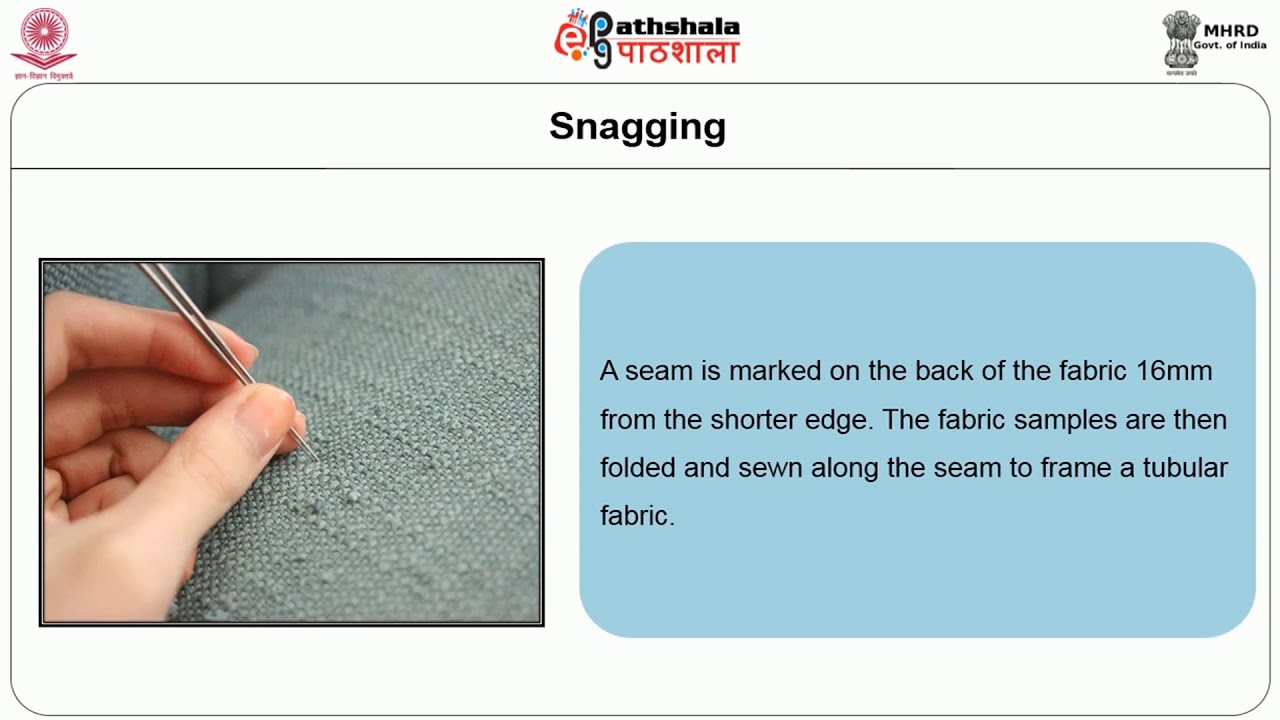
Vidya-mitra’s educational lesson accompanies the INFLIBNET textile manufacturing and testing module on surface properties and colourfastness. It introduces washing and other exposure types and helps explain why their results should be kept separate. The laboratory must still follow the current agreed standard and test option.
Frequently asked questions
Is colour change the same as staining?
No. Colour change describes the tested fabric’s appearance change. Staining describes transfer onto adjacent material. Obtain and review both results separately.
Does passing a washing test prove resistance to rubbing?
No. Rubbing uses a different exposure and assessment. Include dry and wet rubbing checks where the intended garment and customer specification require them.
Can one shade represent every colour in the collection?
Do not assume so. Define the sampling and colour coverage with the buyer and laboratory, and keep results connected to the actual shades and lots assessed.
Does an accelerated test guarantee an exact garment lifespan?
No. Its controlled exposure supports comparison and approval under the stated conditions. Real care practices and garment construction vary, so avoid an unsupported wash-life promise.