



















































































































Colorfastness to Light: Xenon Reports and Printed Fabric Checks
Colorfastness to light is a textile’s resistance to colour change during a specified light exposure. A useful report identifies the method, exposure conditions, reference system and tested material. It does not automatically predict how many months a garment will keep its colour outdoors. For printed apparel buyers, review the actual colourway and finishing state, keep an unexposed comparison and assess the design’s appearance after the agreed exposure. Lightfastness is separate from UV protection for the wearer and from washing or rubbing fastness. Each claim needs evidence that answers its own question.
Describe the appearance that must remain acceptable
A print may contain several colours whose relationship matters as much as the overall brightness. Decide whether the concern is a shift in a background shade, reduced contrast in a motif, or a change that makes matching panels look different. Identify the intended use and the customer’s approved appearance reference. A statement such as fade resistant is too broad to guide an assessment.
Keep a representative unexposed sample from the same material. Record the product reference, colourway, lot and finish before it is sent for testing. Photographs help document the design, but lighting, camera settings and screen display can alter apparent colour. Use the agreed laboratory evaluation and physical comparisons for the approval decision rather than judging two uncontrolled phone photographs.
Read the method option, not only the test name
The published AATCC TM16.3 scope includes different xenon-arc options. It also states that the relationship between a test and actual use exposure must be agreed by the contractual parties. A laboratory result should therefore not be converted into an unsupported promise of a fixed outdoor life.
ISO 105-B02:2014 describes an artificial-light method representative of daylight and notes that its two blue-wool reference sets may not give identical results. Check the reference and reporting basis. A result with the same-looking number under another method or reference system is not automatically a like-for-like comparison.

Keep the laboratory exposure and real use distinct
Ask the laboratory to identify the selected exposure and assessment endpoint. Do not use an instrument’s running time alone as a universal measure of severity. A report should provide enough context to understand what the specimen experienced and how the change was assessed. If a customer requirement is expressed differently, obtain a technical interpretation rather than guessing an equivalence.
Real garments encounter changing light, orientation, wear, care and storage. A controlled light test supports a defined comparison, while a garment-use claim requires a justified relationship to its application. Keep this distinction visible in sales and purchasing language. Saying that a sample met an agreed test requirement is more precise than suggesting the same result guarantees permanent colour outdoors.
Use a comparison table that preserves the conditions
| Report field | Why it matters | Buyer action |
|---|---|---|
| Method and option | Identifies the chosen light-exposure arrangement | Match the customer requirement |
| Exposure endpoint | Defines the point at which change was assessed | Do not compare time alone |
| Reference system | Provides the assessment basis | Keep different systems explicit |
| Colourway and lot | Connects the result to the proposed print | Check actual material coverage |
| Preparation and finish | Identifies the specimen’s tested state | Review changes before reusing evidence |
| Acceptance criterion | Separates measurement from commercial approval | Agree it before testing |
This checklist does not prescribe a universal passing grade or exposure duration. Use the buyer’s applicable specification. If two reports differ in method or conditions, clarify those differences before ranking the fabrics. A neat spreadsheet should preserve the evidence’s meaning rather than conceal unlike tests in one column.
Evaluate the actual printed product
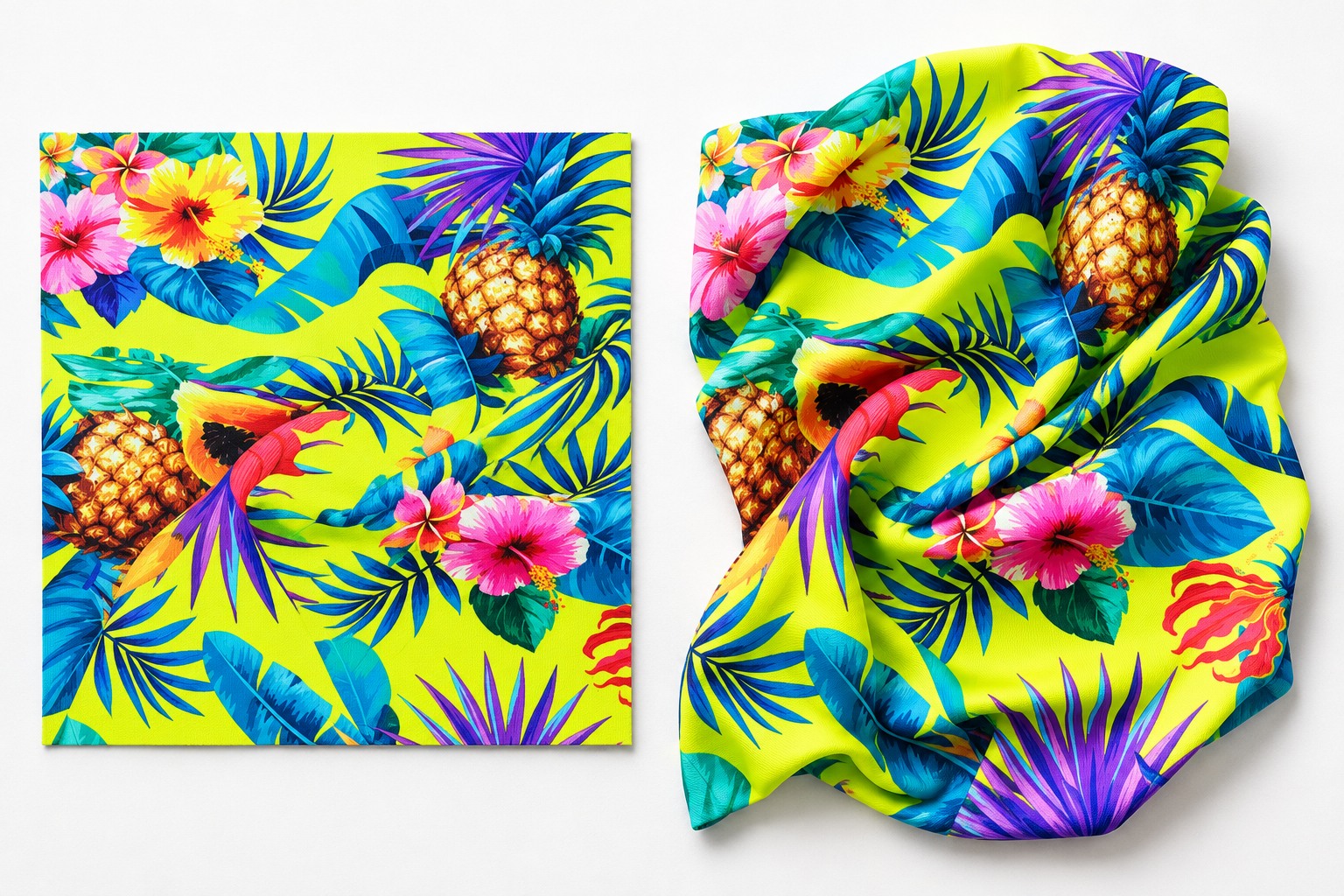
Shengchao’s digital-printed nylon-spandex fabric is relevant to a printed apparel development enquiry. Its tropical print provides an identifiable material reference, not a measured lightfastness result. Ask for the exact proposed artwork, colourway, base fabric and final finishing state, along with relevant evidence for the material offered for the order.
The digital print development guide provides the parent sampling workflow. Connect lightfastness approval with that process so that the tested specimen matches the approved design. A later change to a colour, base material or processing route should trigger a review of whether the earlier report still answers the buyer’s requirement.
Plan coverage across motifs and colourways
A multi-colour design needs a deliberate sampling approach. Discuss which visible areas and colour combinations should be assessed, and retain enough material to identify them clearly. Do not assume that testing one background shade covers every accent colour. The laboratory and customer should agree how the selected specimen represents the design and how the reported outcome will be interpreted.
Keep the artwork version and colourway identifier with the physical sample. If motifs repeat, record which area was used for comparison without claiming that a photograph provides a colour measurement. For a collection, document the scope of each report. An approval should make clear which variants were assessed and which remain outside its evidence, rather than silently extending a result across the entire catalogue.
Review colour relationships after exposure
Inspect the exposed specimen against its matching retained reference using the agreed assessment conditions. Note whether the overall appearance changes and whether specific motifs lose their intended relationship. Keep any observations alongside the formal result, with clear separation between the laboratory assessment and the development team’s design judgement. A buyer may need both to decide whether the print still suits the garment.
If a colour changes unexpectedly, retain the specimen and ask for a focused review of sample identity, exposure and assessment. Do not immediately blame the printing route or fibre type without evidence. The response may involve revising a colour or checking processing, but the proposed change should be evaluated on a new representative sample before it is accepted for production.
Do not confuse lightfastness with wearer UV protection
The UPF fabric guide addresses protection against ultraviolet transmission through material. A colourfastness report concerns the textile’s colour response. Neither should be substituted for the other. If the garment makes a protective claim, obtain the appropriate evidence for that claim and for the material state in which the product will be used.
Likewise, the washing fastness guide concerns a separate exposure. A sample can meet the agreed washing requirement while needing further work on light exposure, or the reverse. Keep those decisions separate in the approval record. A general statement that a fabric passed fastness testing is incomplete unless the relevant exposures and conditions are identified.
Connect laboratory approval with garment development
Use the proposed print in a representative garment, including contrasting panels and trims. Review the design’s appearance and the relevant care process. If a particular use trial is required, define its purpose and conditions before starting. Do not present a small outdoor observation as a standardized lightfastness test or use it to make broad claims about every climate and wearer.
Document any change made after testing. A different lining may not change the print’s laboratory result, but a new finishing process or base fabric can make the original sample less representative. The development team should review which evidence needs to be updated. Keep the approved physical reference so that production and quality teams can identify the material the decision actually covers.
Write claims and reorder instructions carefully
For example, a tropical print approved on one base fabric may later be requested on another material. Preserve the artwork reference, but do not assume that the earlier test report transfers with the design file. Identify the new base, processing route and colourway, then agree the relevant repeat evaluation. Compare the new specimen with its own retained reference. This keeps the approval connected to the supplied textile instead of treating an attractive design as though it carries a permanent, material-independent fastness rating.
A clear testing request names the product, artwork version, colourway, lot, finish, method and required assessment. Attach the customer specification and ask for missing details to be resolved before exposure. Keep the complete report and acceptance decision together. For repeat orders, identify when fresh testing is required under the agreed quality plan instead of copying an old pass statement without checking its scope.
If a customer reports fading, preserve an unused comparison and the affected item with its available care and use history. Review the original report’s conditions before deciding what additional evidence is needed. The outcome should identify the affected material, the finding and the corrective action. Avoid defending an unrelated test result or promising an exact service life that the evidence never established.
Watch an educational colourfastness overview
Vidya-mitra’s INFLIBNET lesson covers colourfastness properties, including light exposure, alongside other textile assessments. It helps distinguish the different questions addressed by testing. The lesson supplies context; the laboratory should follow the agreed current method and the buyer’s actual requirement.
Frequently asked questions
Does a lightfastness report guarantee years without fading?
No. AATCC’s published scope cautions against assuming a specific actual-use relationship. Any service-life claim needs separate justification.
Is lightfastness the same as UPF?
No. One concerns colour change; the other concerns ultraviolet transmission and wearer protection. Use the relevant evidence for each claim.
Can different reference systems be treated as identical?
Not automatically. Preserve the method, reference system and exposure conditions when comparing or interpreting results.
Should a changed print colourway use the old approval?
Review its coverage first. A different colour, base material or processing route may need fresh representative testing.