



















































































































Fabric Steam Shrinkage: Suiting Reports and Cutting Approval
Fabric steam shrinkage describes a reduction in fabric dimensions after a defined steam exposure. A useful report identifies the finished material, measurement directions, conditioning and treatment procedure. It should also report growth where that occurs, rather than forcing every dimensional change into a positive “shrinkage” figure. For suiting and trousers, the practical question is whether the selected fabric remains compatible with cutting, assembly and finishing. Free-steam evidence helps answer part of that question; it does not automatically approve washing stability, pressing appearance, seam behaviour or a finished garment’s fit.
This guide explains how buyers can separate those questions and request usable evidence. It is a report-reading and sampling guide, not instructions for operating steam equipment. Laboratories and garment factories should follow the applicable procedures and their own equipment safety requirements.
Separate free steam from pressing and washing
A fabric can encounter moisture and heat in several different ways. Washing combines a specified liquid treatment with handling and drying. Pressing can introduce contact pressure, restraint and shaping. A free-steam dimensional-change procedure addresses its own defined exposure and sample arrangement. Similar words in the finishing department do not make these treatments interchangeable.
ISO 3005:1978’s public scope concerns dimensional change induced by free steam. It explicitly excludes the consolidation and felting shrinkage associated with wet treatments and the mechanical effects of pressing. That boundary matters when a buyer tries to use one report to approve every later stage of garment production.
Write down the process causing concern. If a trouser panel changes after finishing, record the fabric state and actual operation rather than assuming the cause is steam alone. A free-steam assessment can be one controlled part of the investigation, while a factory trial checks the relevant production sequence. Keep those records connected, but label each assessment accurately.
Identify the sample and its manufacturing state
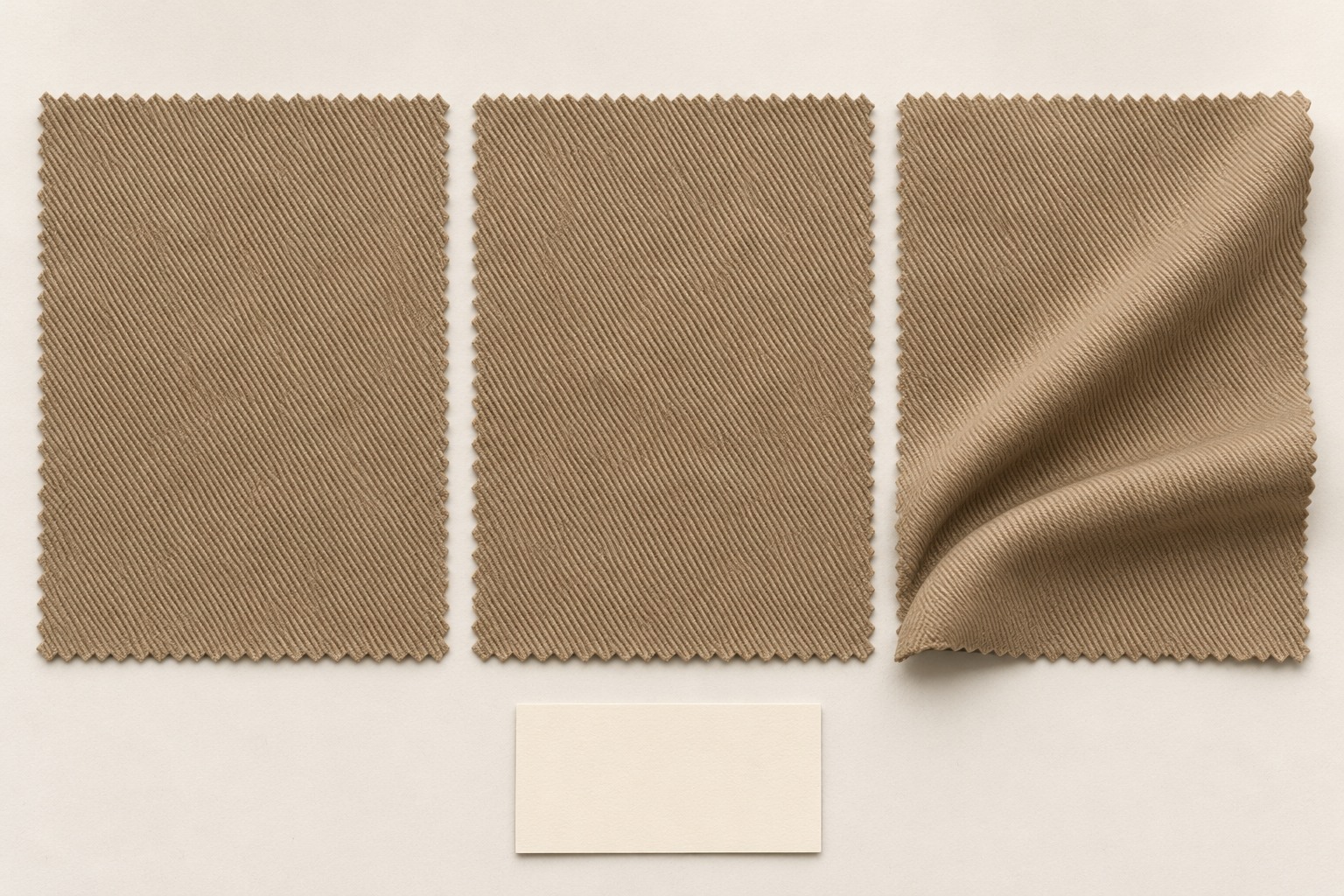
Use the complete fabric reference, lot, colour and finish state. State whether the material was supplied as a development sample, finished bulk fabric or a piece that already passed through another treatment. Record length and width directions before cutting. If samples are sent by more than one team, use one shared identification system so the laboratory does not receive ambiguous duplicates.
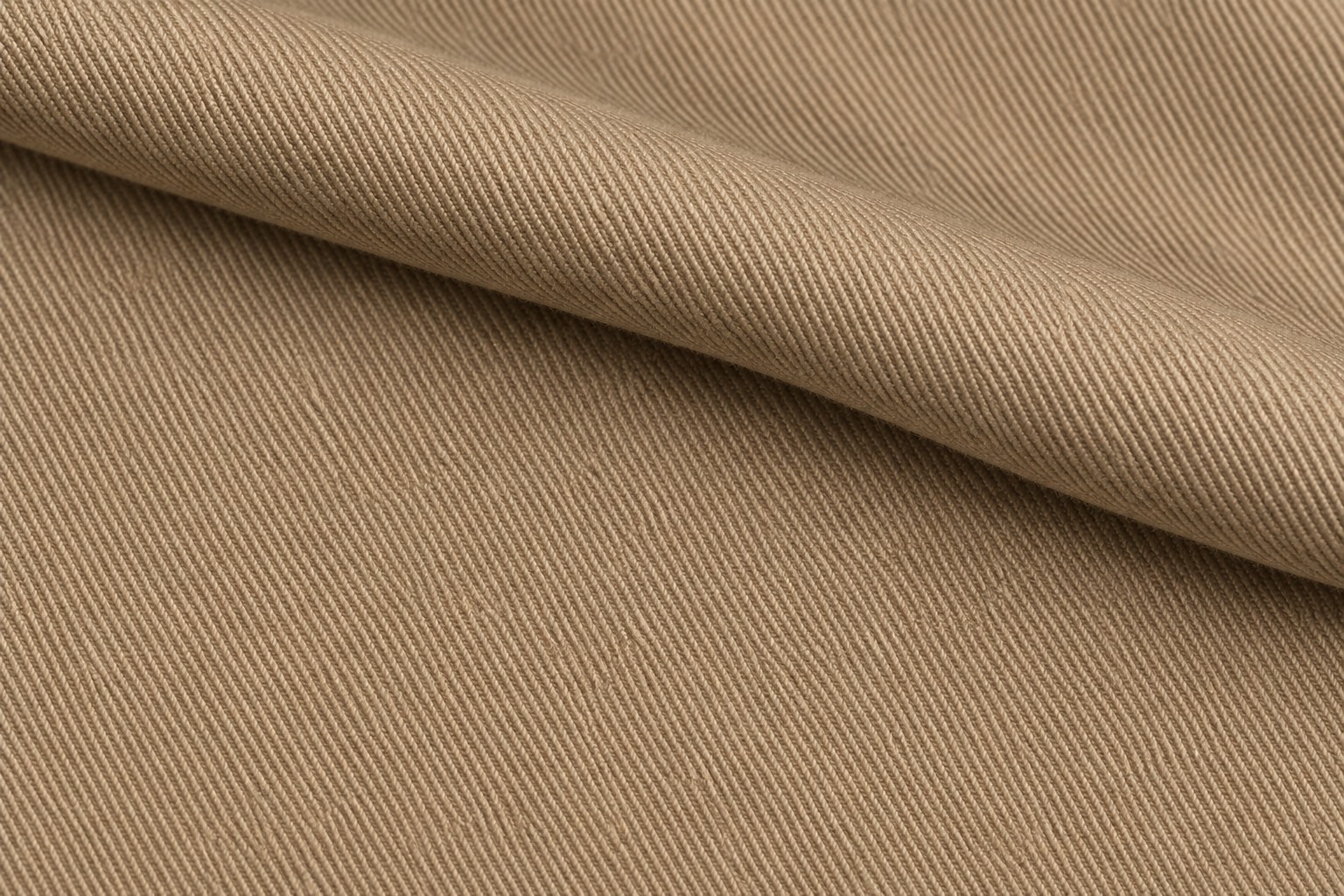
Shengchao’s 68% cotton, 32% polyester suiting fabric is a relevant development candidate: its listing identifies twill construction and suiting or trouser uses. The warm tan photograph shows a fine diagonal texture. These details help connect a sample request to a specific material; neither the composition nor the photograph establishes its steam-shrinkage result.
Ask the supplier which current finishing route the proposed sample represents. If the route changes during development, review whether the earlier report still applies. Do not transfer approval from a different construction simply because the fibre percentages match. Similar blends can arrive with different histories and require their own traceable sampling decisions.
Check what the laboratory actually measures
The public description of SATRA TM211 describes conditioned length- and width-direction specimens, free of tension during steam treatment, followed by relaxation, further treatment stages, reconditioning and measurement. It reports average percentage dimensional change in both directions. This is a method-specific sequence, not a reason to improvise exposure times from a summary page.
Before submitting specimens, ask which complete method and edition the laboratory proposes to use. Confirm sample quantity, relevant directions, any preparation already performed and how deviations will be documented. If the customer requires a particular method, retain that requirement rather than replacing it with whichever test is most convenient without agreement.
Review the measurement records with the reported result. Initial and final values should belong to the same marked positions and units. If a report gives only “passed steam test,” request the underlying method, directional results and acceptance requirement. A short pass statement is difficult to apply to a cutting decision when the original specification cannot be found.
| Buying concern | Evidence to request | What remains separate |
|---|---|---|
| Fabric size after free steam | Named size-change method and both directions | Mechanical shaping during pressing |
| Panel behaviour during production | Controlled trial of the actual finishing sequence | Consumer-care stability |
| Fit after washing | Agreed washing and drying assessment | Free-steam performance |
| Colour after ironing | Pressing colour test | Dimensions and surface appearance |
This table separates questions rather than prescribing one test package for every garment. The laboratory, supplier and garment team should agree the programme around the product and the claim.
State the calculation convention clearly
For a general illustration, signed dimensional change can be written as: change (%) = (final measurement − initial measurement) ÷ initial measurement × 100. Under this convention, a negative number indicates reduction and a positive number indicates growth. Some reports express shrinkage as a positive reduction instead. Read the convention used by the applicable procedure before interpreting a sign.
Suppose a marked reference distance is 250 mm before treatment and 247.5 mm after treatment and the required reconditioning. The signed change is (247.5 − 250) ÷ 250 × 100 = −1.0%. Expressed as positive shrinkage, the same reduction is 1.0%. These are invented arithmetic inputs to illustrate interpretation, not measured results for the featured suiting and not an acceptance limit.
Use like units, an initial value greater than zero and the same measurement direction throughout the calculation. Keep length and width results separate. If one direction contracts while the other grows, a single average can conceal the pattern. Follow the method’s rules for specimen aggregation and rounding; do not improve an apparent result by choosing a different rounding convention after testing.
Connect dimensional change to cutting approval
A directional result becomes useful when the pattern and manufacturing teams understand what it represents. A long trouser panel, waistband and pocket assembly do not all behave as an isolated flat swatch. Their cut direction, component compatibility and finishing sequence need consideration. Use the laboratory evidence to guide trials, then verify the proposed construction before releasing bulk cutting.
For the wider dimensional-stability framework, read the parent fabric shrinkage guide. Keep recovery from folding separate through the related fabric crease-recovery checks, and consider assembly compatibility with the fabric seam-strength guide. A satisfactory result in any one area should not be presented as approval of the others.
A factory may propose a stabilisation step before cutting. Record the process, the fabric identity and the verification plan. Do not choose a blanket pattern allowance from a generic internet percentage. An allowance should be based on representative evidence and confirmed in the relevant garment development, including the direction in which each component is cut.
Investigate variation before changing the order
If results differ between submitted pieces, start with sample identity and handling. Check whether the specimens came from the same lot and finishing state, whether directions were marked consistently and whether all measurements followed the same agreed procedure. A different preparation history may explain an apparent disagreement without proving that the entire fabric programme is unsuitable.
Ask for individual specimen results when they are relevant to the investigation. A mean alone may hide inconsistent behaviour. Discuss the laboratory’s interpretation and suitable follow-up work rather than selectively repeating the most favourable specimens. If a procedure was modified, preserve that qualification wherever the result is quoted.
When a corrective finishing route is introduced, request a new representative sample and keep the original material record. Compare the revised version against the actual requirement, and check any other properties affected by development. A change intended to improve dimensional stability still needs review for hand feel, appearance and assembly behaviour; it should not inherit every previous approval automatically.
Use fibre-science background with the right limits
The American Chemical Society’s Reactions video explains why clothes can shrink and introduces the role of fibres and care. It is useful background for conversations between purchasing and garment teams. Its wash-related examples are not a demonstration of ISO 3005 or SATRA TM211, and they cannot predict the result of the tan suiting shown here.
A focused enquiry could read: “Please identify the current suiting sample and finishing state, recommend the required free-steam dimensional-change assessment, and report the length and width results with the calculation convention. We also need a separate production trial for our pressing sequence. Confirm sampling, reporting of deviations and the agreed acceptance requirement before testing.”
Attach the garment type, intended component directions, planned finishing and care routes, available sample quantity and decision deadline. Specify who will retain the approved fabric and where laboratory and factory-trial records will be stored. That record allows later bulk deliveries to be reviewed against the actual development decision rather than against a disconnected headline percentage.
Frequently asked questions
Does free-steam stability prove washing stability?
No. The treatments ask different questions. Specify the intended washing and drying assessment separately when consumer-care performance matters.
Can a positive shrinkage value mean a negative dimensional change?
Yes. Some reports show reduction as a positive shrinkage percentage, while signed dimensional change shows it as negative. Confirm the report’s convention before comparing values.
Does a cotton-polyester blend guarantee low steam shrinkage?
No. Composition is only part of the material identity. Test the actual finished construction and sample state relevant to the order.
Should I apply the test percentage directly to the pattern?
Do not do so automatically. Review directional evidence with the pattern and production teams, then verify the proposed allowance through representative garment trials.