



















































































































Colorfastness to Sea Water: Swimwear Report and Sample Checks
Colorfastness to sea water evaluates how a textile’s colour responds to a specified sea-water exposure, including change in the specimen and staining of adjacent test material. For swimwear development, request both sets of results with the method, colourway and finished sample identity. A satisfactory colour result does not prove retained elasticity, resistance to pool chlorine or a guaranteed number of beach outings. Treat sea-water fastness as one defined part of a wider approval programme, then keep the laboratory evidence tied to the exact material and claim.
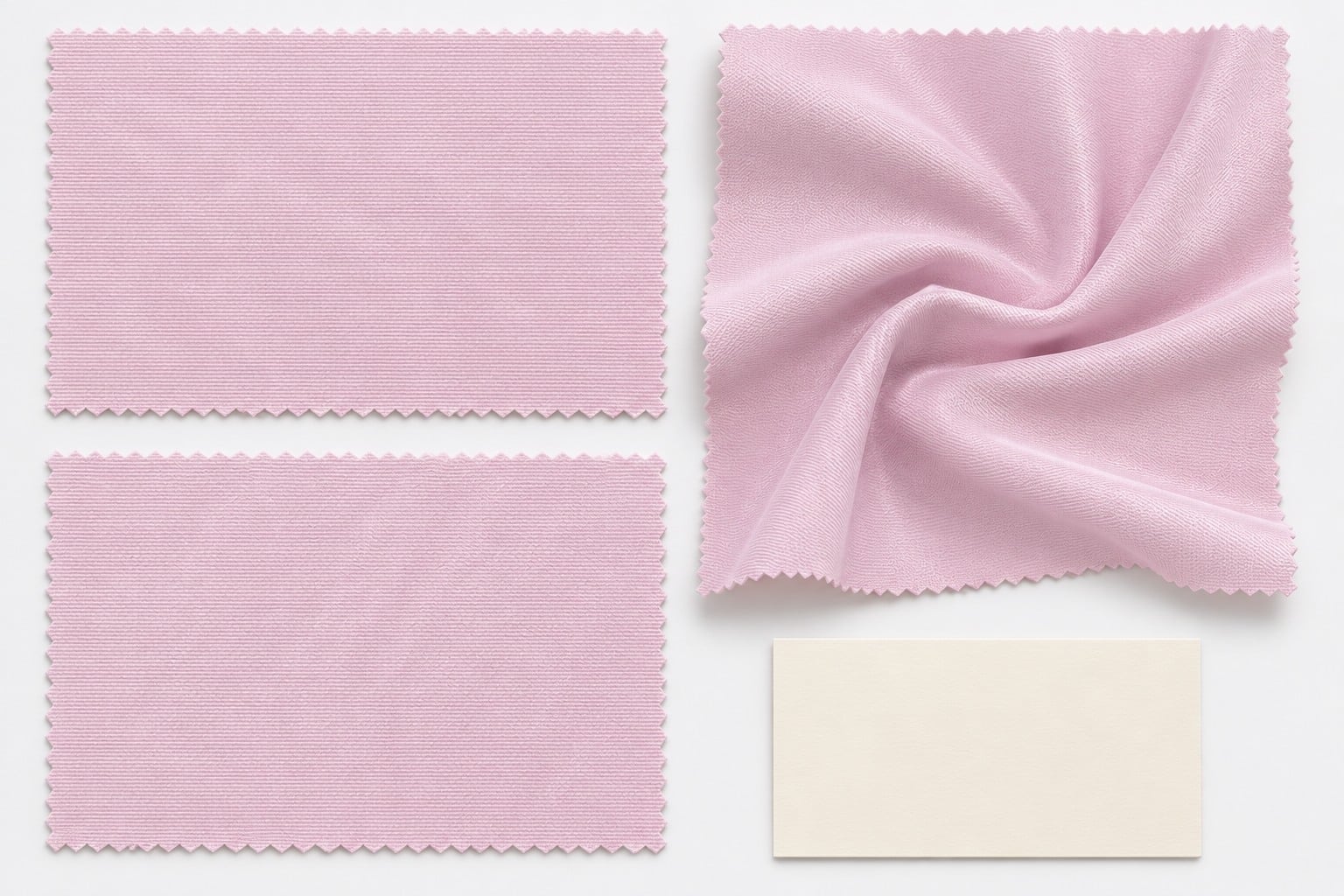
This guide is for buyers comparing reports and planning representative submissions. It does not provide a complete laboratory procedure or claim that the pale pink fabric illustrated has achieved a particular grade. Its photographs show a sampling candidate, rather than tested before-and-after specimens.
Define the exposure before requesting a report
“Water resistance” is too vague for a colourfastness enquiry. A beachwear programme might be concerned with a coloured panel staining pale trim after wet contact. Another project may involve repeated pool use, perspiration or laundering. Record the actual concern and customer requirement first, so the laboratory can select the relevant assessments.
ISO 105-E02:2013 specifies a method for assessing textile colour resistance to immersion in sea water. Its public listing identifies the exposure and the standard’s scope. That title should not be shortened to a generic “water test” when the result is transferred into a product approval sheet.
If the purchase specification names another procedure, ask the laboratory to confirm how it will be followed. Do not silently substitute a nearby method number. When more than one exposure is needed, list the tests separately and explain what each is meant to support. This prevents a sea-water result from gradually becoming a broad claim about every wet environment.
Read colour change and staining separately
The AATCC TM106-2025 public summary describes artificial sea water and an assessment involving a specimen and multifibre test fabric under specified conditions. It explains that the colour change of the specimen and staining of the attached material are observed. The summary also identifies TM106 as partly equivalent to ISO 105-E02, which is a reason to verify the requested method rather than treating both labels as identical instructions.
Colour change concerns the submitted fabric’s appearance after the procedure. Staining concerns transfer to the adjacent test material. A fabric may look relatively unchanged yet transfer colour to another surface. For a swimsuit with pale components, the second question can be commercially important even if the main panel still looks attractive.
Request the individual staining assessments required by the method, not only the most favourable entry or one unexplained overall grade. Keep the report’s evaluation convention and buyer acceptance requirement together. A method describes a test; it does not supply a universal pass level for every swimwear collection, market or contract.
| Claim or concern | Relevant evidence | Do not infer |
|---|---|---|
| Colour after sea-water exposure | Named sea-water fastness method and colour-change result | Lifetime beach durability |
| Transfer onto pale trim | Individual staining results and assembly review | No transfer in every garment |
| Colour after pool use | Separate pool-water test | Coverage by a sea-water result |
| Stretch retained after exposure | Strength and stretch tests | Proof from colour grading alone |
The table helps assign questions to evidence. The final programme should follow the customer requirement and laboratory advice, with agreed sample preparation and decision rules.

Identify the actual fabric, colour and finish
Use a complete specimen code that links the report to the order. Include the fabric reference, colour or artwork reference, lot, face orientation and finish state. For a plain fabric, submit the actual planned shade. A report for pale pink should not automatically approve a dark navy version, and a result for one material should not be transferred to another on the basis of similar photographs.
Shengchao’s Lycra Swimwear Fabric product page offers a relevant swimwear sampling direction and shows a pale pink, subtly lustrous textile. Its product naming and detailed material description are not fully consistent. Confirm the exact composition and commercial specification with the supplier before ordering; do not infer fibre identity from the page title or visible sheen.
The photograph is useful for checking which product is being discussed, but it does not establish dye chemistry, salt-water durability, a colour grade or stretch retention. Ask for a current physical swatch and confirm which finished version will be submitted. Record any development change rather than letting a familiar product name conceal a different material.
Plan representative colours and contrasting components
A collection with several shades needs a sampling rationale. Agree the required coverage with the customer and laboratory. Consider colourways, print coverage and finishing differences, while avoiding an unsupported assumption that one “worst colour” necessarily represents every other shade. The approval record should explain what was tested and what remains outside its scope.
For printed swimwear, make sure the submitted piece contains the relevant colours and a representative pattern area. For garments with contrasting trims, identify the material combination and request advice on suitable additional checks. A standard adjacent fabric is controlled test material; it is not automatically identical to the buyer’s pale lining, binding or elastic component.
Keep physical references of approved components. If the garment maker changes a lining or trim later, review whether the assembly decision needs revisiting. This is particularly useful when fabric development and garment production are handled by different teams, each using its own component codes.
Keep sea water, chlorine and plain water distinct
A sea-water assessment should remain separate from other exposure claims. The broader swimwear fabric selection guide provides a parent topic for balancing fabric properties around the intended use. The related chlorine-resistant swimwear testing guide explains why colour and mechanical properties require distinct evidence, while the colourfastness-to-water guide addresses the separate plain-water question.
A saltwater swimming pool also needs a clear description of its treatment system and the claim being investigated. Do not assume the everyday word “saltwater” makes a sea-water method a complete pool-durability assessment. Ask the laboratory which exposures and properties are relevant, and preserve the reasoning with the test request.
Likewise, a swimsuit can face sunlight, wet handling, rubbing and care processes. A narrowly worded colour claim is easier to support than an unqualified promise that the garment is immune to every beach condition. Build a programme around the actual intended statement instead of widening a single test result after the event.
Specify sample preparation and reporting details
Tell the laboratory whether the specimen is new, prewashed or otherwise treated. If performance after care is part of the requirement, agree the care route and paired submissions before testing. Do not compare an untouched sample with one that has been washed repeatedly without identifying that difference. Preparation history belongs in the report alongside the exposure method.
Ask for the method edition, specimen identification, relevant preparation, reported colour change, required staining entries and any deviations. Include the acceptance criteria and their source in the request. If the report cannot be tied to the submitted lot or colour, resolve that gap before using it as bulk approval evidence.
When reviewing an unexpected outcome, retain the tested specimen and an untested reference where appropriate. Discuss how the observations were evaluated and whether further investigation is needed. A phone photograph of a wet sample is not a replacement for the method’s specified evaluation, and it should not be used to revise an inconvenient laboratory grade informally.
Investigate a failed result without hiding its scope
Begin with identity and preparation checks, then review the relevant dyeing or finishing route with the supplier. Ask what changed between versions and whether corrective work affects the proposed product specification. Do not state that every fabric with the same fibre family will fail, or that a generic finishing treatment will guarantee a particular improvement.
Submit a representative revised sample when a change is made, and keep the earlier result in the development history. If the customer accepts a different specification, record that agreement openly. Replacing the acceptance rule after testing without documenting the change makes later purchasing decisions difficult to defend.
Approve only the material, colours and conditions actually supported by the evidence. Keep outstanding properties visible on the release checklist so a colour pass is not mistaken for completion of the entire swimwear programme.
Watch how colourfastness evaluation is organised
Vidya-mitra’s educational lesson introduces colourfastness evaluation and is useful background for understanding why colour change and transfer must be considered separately. It is a general textile-colouration lesson, not a demonstration that the pictured product passes a sea-water method. Use the laboratory’s selected standard for the actual assessment.
A useful enquiry could read: “Please confirm the exact swimwear sample composition and colour reference, then quote the required sea-water colourfastness assessment. Report colour change and the required individual staining results. Identify method edition, preparation and deviations, and confirm the agreed acceptance criteria. Please keep chlorine resistance and retained stretch as separate requirements.”
Frequently asked questions
Does sea-water colourfastness prove chlorine resistance?
No. These are distinct exposures. Request the appropriate chlorinated-water assessment separately when pool-use claims are needed.
Can a colourfastness pass prove the fabric retains stretch?
No. Colour grading does not establish elasticity or recovery after exposure. Agree suitable mechanical-property checks for the intended claim.
Does one tested colour approve every shade?
Not automatically. Define representative sampling and the coverage of the approval with the customer and laboratory, especially when colours or finishing routes differ.
Why keep staining results if the specimen looks unchanged?
Transfer to adjacent material is a separate concern from the main fabric’s colour change. It can matter for pale trims, linings and contrasting garment components.