



















































































































Nylon vs Polyester Swimwear: How to Choose and Test the Fabric
For nylon vs polyester swimwear, choose by the finished fabric’s wet fit and exposure performance, not the fiber name alone. Nylon-spandex is often shortlisted for a smooth, supple fashion-swim feel. Polyester constructions are often shortlisted when repeated pool use and color retention are priorities. These are starting tendencies, not guarantees: elastane grade, knit structure, dyeing, lining, and care can change the outcome. The reliable choice is the sample that meets your garment’s wet-opacity, recovery, colorfastness, and exposure requirements.
This comparison is for apparel buyers deciding between two material families. It goes beyond a general swimwear-fabric list to show which evidence matters before approving a specific fabric.
The decision starts with the swim program
A resort bikini, a weekly exercise suit, and a daily training suit do not share the same priorities. Write down the expected swimming frequency, pool or seawater exposure, fit, coverage, print process, and care routine. A fabric selected primarily for a soft hand may be appropriate for a fashion collection without being the best starting point for a high-frequency chlorinated-pool program.
Do not reduce that distinction to “nylon for beaches, polyester for pools.” Both families can appear in different swim programs, and construction-specific evidence should decide approval. Likewise, a supplier’s “swimwear” category identifies an intended application; it does not establish a particular chlorine exposure life.
Nylon and polyester swim fabrics compared
| Decision point | Nylon-based shortlist | Polyester-based shortlist | Approval evidence |
|---|---|---|---|
| Hand and drape | Often considered for smooth, supple fashion swim | Can range from soft stretch knits to firmer training constructions | Review finished samples and sewn prototypes |
| Pool exposure | Require evidence for the specific yarn and finish | Common starting family for pool-durability briefs; blend still matters | Separate color and mechanical-performance checks |
| Stretch and recovery | Influenced by elastane, knit, and finishing | Influenced by elastane or other elastic construction | Measure both axes before and after agreed conditioning |
| Drying | Depends on water retention and garment construction | Depends on weight, knit, lining, and environment | Same drying method and comparable loading |
| Print appearance | Confirm the process suits the selected base | Confirm heat processing and color compatibility | Printed trial followed by fit and fastness review |
| Recycled content | Verify the yarn claim and traceability | Verify the yarn claim and traceability | Documents tied to the supplied material |
This is a sampling framework rather than a numerical ranking. The ISO 105-E03 colorfastness method and ISO 20932-1 fabric elasticity method address different properties; neither alone proves the full service life of a swimsuit.
Why the spandex content does not tell the whole story
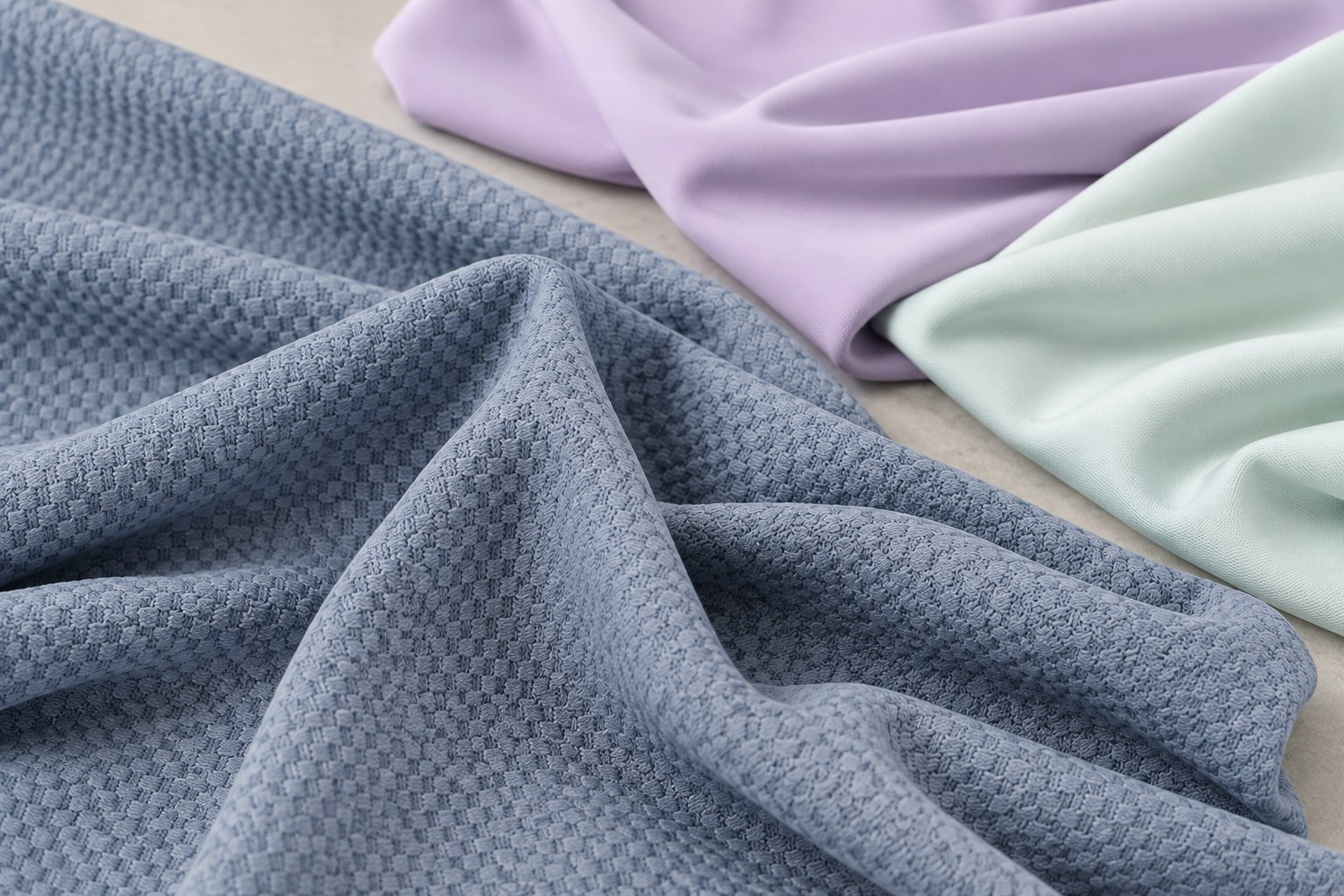
Spandex and elastane are names for the elastic fiber commonly used in stretch swim knits. A higher percentage does not automatically mean better recovery, greater comfort, or longer pool life. Yarn selection, placement within the knit, heat setting, and fabric density influence the force needed to stretch the material and its ability to return.
Two fabrics can both extend easily by hand while producing different fit pressures in a garment. One may grow after repeated loading; another may feel too restrictive across a seam or around an opening. Review extension and recovery together, in both principal directions, with the pattern and intended negative ease in mind.
For frequent pool use, ask whether the elastic yarn is a documented chlorine-oriented grade and request evidence for the finished material. Do not transfer a named fiber’s marketing claim to an unidentified fabric. Even a documented yarn does not eliminate the need to check seams, elastics, lining, dyes, and the complete garment.
Chlorine resistance needs more than a color result
A suit may retain its shade while losing recovery, or keep its shape while a print becomes visibly altered. These are separate failure modes. Agree which aspects of appearance and mechanical behavior will be evaluated after exposure, rather than accepting one report as a blanket “chlorine proof” certificate.
ISO 105-E03 concerns color resistance to chlorinated water. It should not be described as a measurement of elasticity retention or guaranteed swimming hours. Ask the laboratory to select suitable procedures for your material and intended claim, and document the exposure conditions used for any additional durability assessment.
For commercial approval, define the pool-use assumptions, care instructions, comparison benchmark, and acceptance levels in writing. Results for an unprinted development color may not answer the same question as results for a finished printed production shade. Match the report to the sample identity and processing stage.
Wet opacity and lining can reverse the decision
A fabric that appears opaque on a table may provide less coverage when wet and stretched over the body. Assess the lightest colors, the highest intended extension, and the actual lining arrangement. Photographing a relaxed dry swatch is not a useful substitute for this garment check.
Lining affects support, drying, bulk, seam handling, and feel against the skin. Confirm its compatibility with the shell under water exposure and repeated extension. A soft shell combined with an unsuitable lining may restrict stretch or leave openings distorted. Evaluate the assembly rather than treating lining as a late purchasing detail.
Patternmakers should see the same approved fabric and lining combination used for the fit sample. Changing the shell weight or elastic response after the pattern is approved may require a new fitting. For pale colors, decide whether a double layer, dedicated swim lining, or a different shell construction is needed before bulk cutting.
Two real Shengchao options illustrate the comparison problem
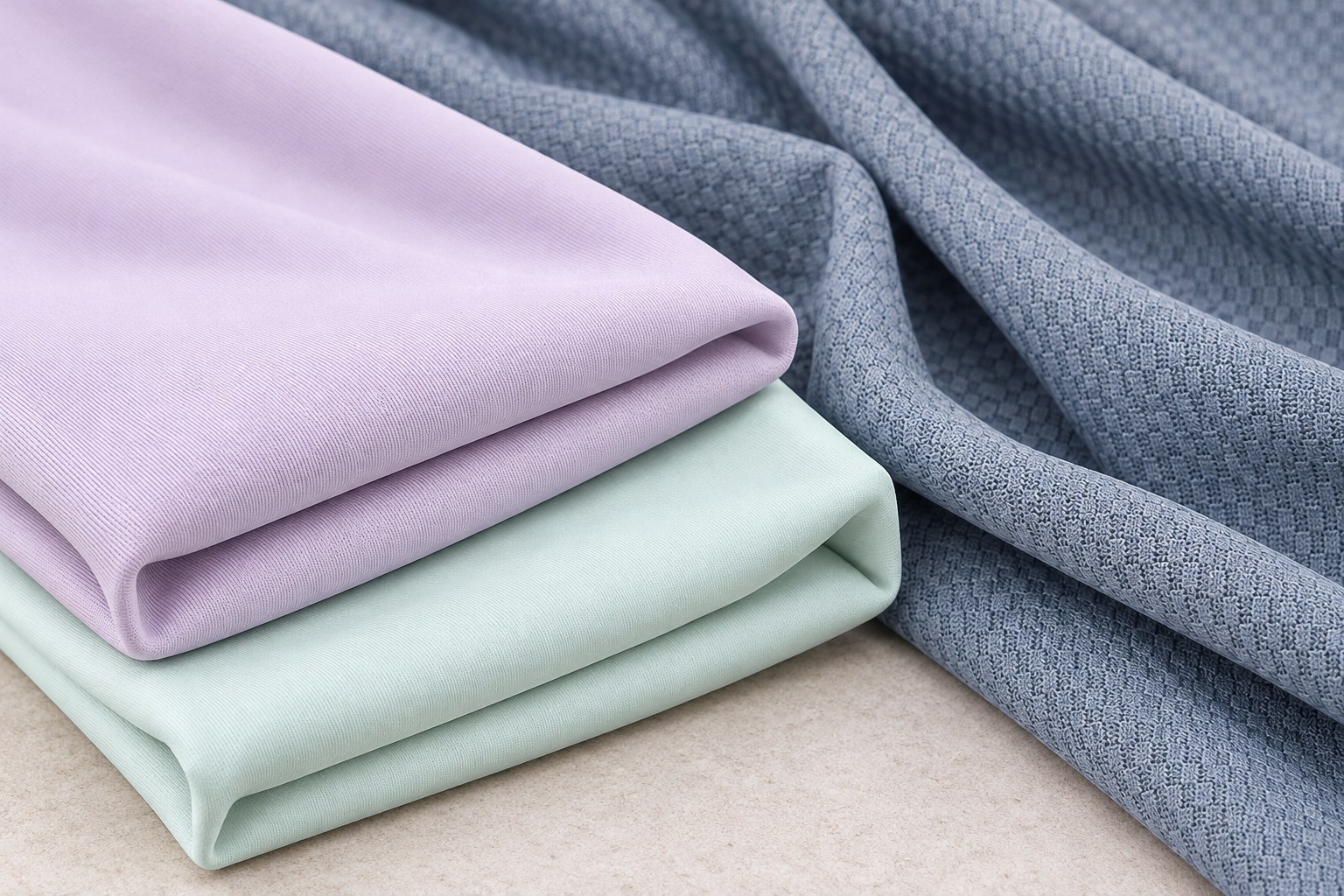
The current nylon-spandex swimwear fabric page lists 84% nylon and 16% spandex, a weight of 180 g/m², and a width of 160 cm. The polyester-spandex swimwear fabric page lists 95% polyester and 5% spandex, 190 g/m², and 160 cm width, with a single-sided knit description.
These are useful identifiers for requesting samples, but they are not a controlled nylon-versus-polyester experiment. Composition, elastic-fiber proportion, weight, and potentially structure differ at the same time. If one feels firmer or dries differently, that result cannot fairly be attributed only to nylon or polyester.
Request current swatches and written specifications, then ask which base best matches the intended garment. Neither listed composition supplies a published recovery value or a verified chlorine service-life figure. A buyer should obtain those results where required instead of inferring them from the product title.
A sample approval plan for either material family
First, establish dry fit and construction compatibility
Record the material code, lot, color, finished width, weight, composition, and surface treatment. Review stretch direction, recovery, sewing behavior, seam appearance, and compatibility with elastics and lining. Use the production print or a representative trial where printing is part of the brief.
Next, assess wet fit and coverage
Review how the prototype fits when wet, including neckline, leg openings, straps, and high-extension zones. Record whether the garment grows, becomes uncomfortable, or loses intended coverage. A garment assessment complements laboratory results because pattern, seam placement, and lining influence the wear experience.
Then, assess the expected exposure
Use laboratory-selected procedures and an agreed development protocol for the relevant water environment, care, and repeated use. Keep color change, stretch retention, surface condition, and seam behavior as distinct observations. Test representative shades and prints rather than assuming every color behaves identically.
Finally, retain a reference and control changes
Keep an approved swatch, a completed fit sample, and the associated reports. Record what must be reassessed if the yarn, finish, dye recipe, weight, print process, or lining changes. An approval that cannot be tied to a stable material specification offers little protection when production substitutions occur.
Pool chemistry: helpful background, not a fabric test
The American Chemical Society’s Reactions video below explains interactions between pool disinfectants and material introduced by swimmers. It provides context for treating pool exposure as a real development condition. It does not compare nylon and polyester or establish how long any swimsuit will last.
Watch the ACS Reactions video on YouTube, or read its official ACS description.
Which fabric should you request first?
For a fashion collection where a supple hand and specific drape lead the brief, request an appropriate nylon-spandex option alongside a polyester alternative. For repeated pool training, start with constructions supported by exposure and recovery evidence, including appropriate polyester-based options. Avoid selecting solely by the lowest price per meter or the highest spandex percentage.
Calculate commercial suitability using usable width, garment consumption, lining needs, testing, and expected rejects as well as the quoted fabric price. A cheaper material that requires pattern changes or additional lining may not reduce the finished garment cost. Agree the technical requirements before comparing final quotations.
For a broader shortlist, read the bathing-suit fabric selection guide. For garment-specific priorities, see fabric for bikinis and stretch-fabric order checkpoints. When ready, send Shengchao Textile your swimwear brief with the water environment, intended use frequency, benchmark, target feel, and required test evidence.
Frequently asked questions
Is polyester always better for chlorine exposure?
No. Polyester-based constructions are common candidates for pool-durability briefs, but the elastic yarn, dyes, finish, and full construction still require evaluation.
Is nylon swimwear more comfortable?
Nylon-spandex is often selected for a smooth, supple hand. Comfort also depends on fit, lining, seams, wet behavior, and the particular fabric, so compare sewn samples.
Does more spandex mean a better swimsuit?
No. Percentage alone does not establish recovery, support, or exposure durability. Evaluate the finished construction and its compatibility with the garment pattern.
Does a chlorine colorfastness report prove shape retention?
No. Colorfastness and mechanical performance are separate properties. Request appropriate evidence for each requirement and match it to the actual fabric.