



















































































































Moisture Wicking vs Quick Dry: How to Compare Fabric Performance
Moisture wicking vs quick dry comes down to transport versus evaporation. Wicking describes how liquid moves through a textile; quick drying describes how rapidly a wet textile loses that water. A fabric can spread a drop well yet remain damp, or dry a small water load quickly without moving sweat efficiently from the skin-facing side. For apparel development, specify and evaluate both properties separately. Neither a polyester label nor a quick-dry hangtag proves that a garment will stay comfortable during sustained sweating.
This guide explains how to separate the claims, compare samples fairly, and turn the results into a useful purchase specification for activewear, travel clothing, and lightweight layers.
What each performance claim actually describes
Moisture wicking: where the liquid goes
Liquid can travel through the small spaces between fibers and yarns by capillary action when the surface and structure allow wetting. This is different from water being absorbed inside a fiber. A synthetic textile can absorb relatively little water into its fibers while transporting liquid through its construction. Fabric treatments, yarn design, knit density, and the relationship between the two faces all influence that behavior.
Wicking also has a direction. A drop spreading sideways across a tabletop swatch does not prove that perspiration moves from the inside of a shirt to its outside. For a next-to-skin garment, identify the intended skin face before testing. The American Chemical Society’s explanation of moisture-wicking textiles is useful background on this transport mechanism.
Quick drying: how the water leaves
Drying occurs as retained water evaporates. Temperature, humidity, airflow, exposed surface area, fabric thickness, and the initial water load affect the result. A lightweight open fabric and a dense stretch knit should not receive an unconditional ranking from one uncontrolled test. Nor should a drying time measured on a single layer be presented as the drying time of a lined or pocketed garment.
Ask what “dry” means in the report. An endpoint based on a defined remaining water mass differs from a person deciding that a swatch feels dry. The test method and conditions are part of the claim, rather than small print that can be omitted.
Moisture wicking and quick dry compared
| Question | Moisture wicking | Quick drying | What a buyer should request |
|---|---|---|---|
| What changes? | Location and distribution of liquid | Amount of water remaining over time | Separate results for transport and drying |
| What can a visual demonstration show? | A wetting front moving through a sample | Only a rough impression unless water loss is measured | Recorded conditions and repeat samples |
| What can cause a misleading result? | Testing the wrong face or only one direction | Unequal water loads, airflow, or fabric weights | Comparable sample preparation and controls |
| What matters after washing? | Whether liquid still wets and travels as intended | Whether drying behavior changes | Results after the agreed care cycles |
| What does it not establish? | Guaranteed cooling or odor control | Guaranteed breathability or waterproofness | Additional evidence for each separate claim |
The distinctions above describe evaluation questions, not pass levels. AATCC lists separate methods for liquid moisture management, wicking, and drying; acceptance criteria must match the intended product.
Why a fabric may pass one check and disappoint in wear
A finish that encourages wetting may help a drop spread across a large area. If the fabric also holds a substantial water load or sits under an impermeable outer layer, spreading alone will not make it dry promptly. Conversely, a small, thin swatch may lose its water quickly in moving air while a tight garment made from it leaves local patches of sweat against the body.
Body contact matters too. The same material behaves differently in a loose overshirt, a close-fitting base layer, and a doubled waistband. Seams, prints, bonded areas, and pockets create local changes that a plain swatch does not capture. Test a garment prototype once the material shortlist is credible.
In humid conditions, the air offers less capacity for additional evaporation than in dry conditions at the same temperature. A “fast” laboratory result should therefore be linked to its environment. Avoid promising that a textile will keep every wearer dry or prevent overheating. Clothing performance is only one part of the activity and environment.
How to choose the right evidence
Begin with the failure you need to prevent. If users report wet cling during running, prioritize skin-side wetting, liquid distribution, fit, and a relevant wear assessment. If travelers need a hand-washed shirt ready the next morning, drying after washing and the effect of seams or double layers become more important. A cycling layer beneath a shell may require a separate review of vapor transfer and the whole clothing system.
Discuss AATCC TM195 for liquid moisture management, TM197 or TM198 for appropriate wicking assessments, and a suitable drying method such as TM199, TM200, or TM201 with the laboratory. These are different procedures; their outputs are not interchangeable scores. The laboratory should identify the current edition, suitability for the material, conditioning, reporting units, and any departures from the method.
Do not invent a universal minimum wicking distance or maximum drying time. Agree a benchmark and commercial acceptance level before testing. An approved reference fabric, evaluated in the same session as candidates, often makes the decision more meaningful than an isolated number supplied without context.
A practical sample comparison workflow
1. Lock the sample identity
Record the fabric code, composition, finished weight, usable width, color, finish, and batch. Mark the skin-facing side and both principal directions. Keep an untouched reference cutting. If two candidates differ substantially in weight or construction, state that clearly rather than attributing every difference to fiber type.
2. Separate the screening questions
For an informal screen, observe where a consistent small drop wets the face and whether liquid becomes visible on the reverse. For drying, compare specimens using a documented water addition and environment. Repeat observations rather than relying on one photograph. These screens help reject obvious mismatches; they do not substitute for a standardized report or authorize a quantified marketing claim.
3. Include care durability
Agree the washing and drying procedure, detergent, use of softener, and number of care cycles. Compare the initial and cared-for samples under the same performance method. A change after laundering may relate to finish durability, residues, or structural change; it should be investigated rather than automatically blamed on one fiber.
4. Make the actual garment
Use the intended print, seam type, lining, and fit. Check damp cling, local wet patches, comfort after activity stops, and drying in the expected use environment. Record subjective wearer comments separately from measured laboratory data. A result such as “preferred by three sample wearers” is useful internal feedback, but it is not a general proof of superior cooling.
How to interpret a real product sheet
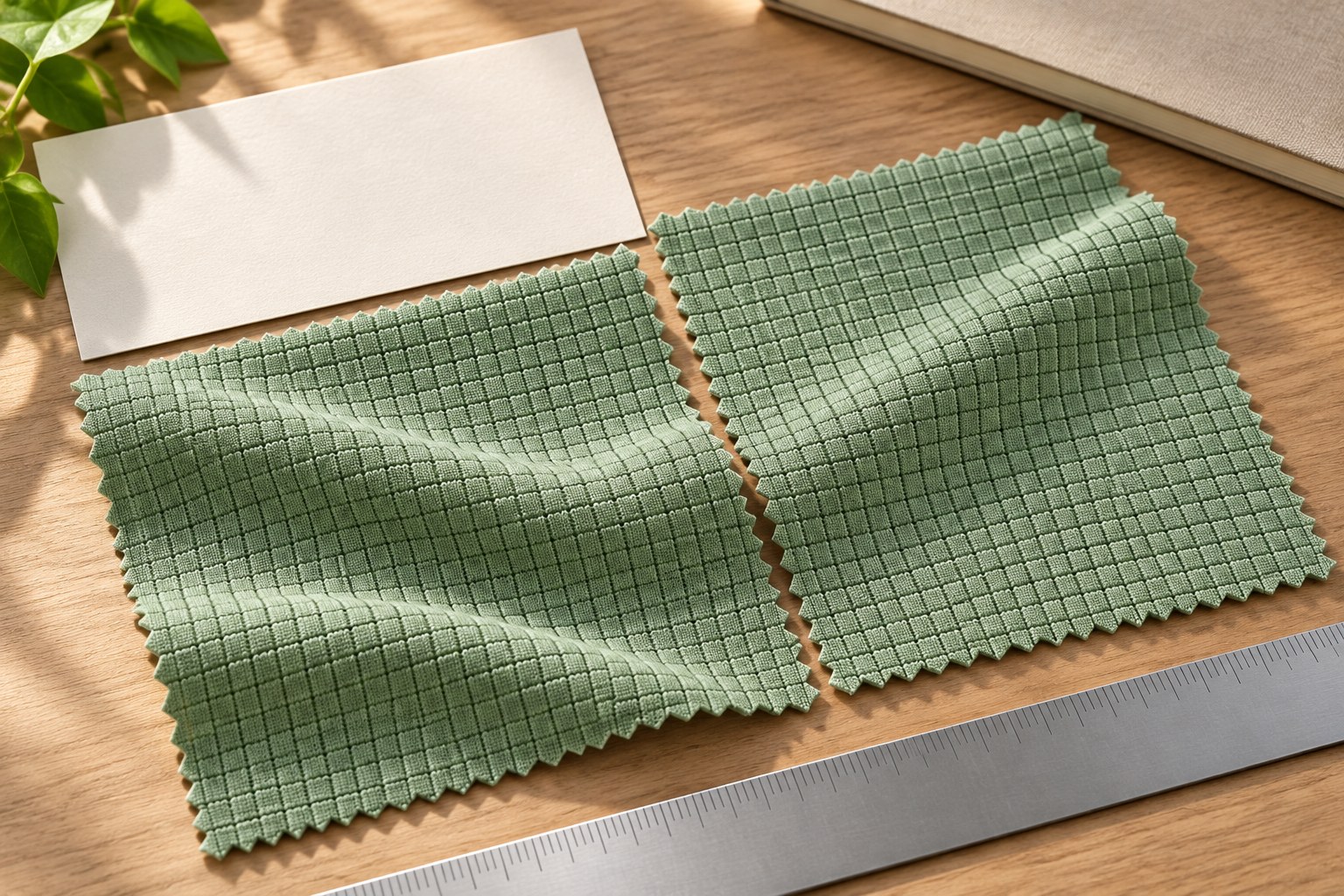
Shengchao’s moisture-wicking polyester fabric is listed as 100% polyester, 160 g/m², and 180 cm wide, with tops and mid-layers as applications. Those details identify a sampling starting point. The composition and stated function do not, by themselves, provide a measured drying time, a wash-durability result, or a guarantee of comfort.
Request a current specification and relevant test results for the actual finish and color you plan to order. Confirm whether the material will sit directly against skin or over another layer. A mid-layer should be assessed in the intended combination, because moisture movement across several layers is a different question from a drop spreading on one swatch.
For broader material selection, use our guide to choosing moisture-wicking apparel fabric. For the structure options behind a shortlist, see types of moisture-wicking fabric. Outdoor developers can also consult the hiking and running fabric guide. Those pages address selection; the present guide addresses how to distinguish and verify two performance claims.
Watch the capillary-action principle
Khan Academy explains adhesion, cohesion, and capillary action in the lesson below. It is background science for understanding liquid movement, rather than a demonstration or endorsement of any Shengchao fabric. Textile performance still depends on the particular yarns, surfaces, and construction.

Watch the Khan Academy lesson on YouTube.
What to include in your sample request
Send the garment type, activity, climate, fit, target weight, expected care routine, and the main failure you want to avoid. Name an existing garment or approved swatch when possible. Ask for a transport assessment and a drying assessment rather than a single unsupported “moisture management” claim.
Define which report belongs to which sample and whether testing covers the finished color, print, and post-wash condition. Agree the acceptance criteria and responsibility for retesting if the bulk construction or finish changes. This keeps a promising development sample from becoming an untraceable performance promise.
Use our fabric development brief checklist to organize those details, then contact Shengchao Textile with your benchmark and intended end use. Requesting comparable evidence at the sampling stage makes it easier to choose the material for a specific garment.
Frequently asked questions
Is quick-dry fabric always moisture wicking?
No. A fabric may lose a small water load quickly without transporting sweat effectively from its skin-facing side. Check liquid movement and drying separately.
Does moisture wicking mean waterproof?
No. Wicking concerns liquid transport within a textile. Waterproofness concerns resistance to water penetration under defined conditions and requires different evidence.
Is polyester automatically a quick-dry performance fabric?
No. Fiber content alone does not establish the behavior of the finished textile. Weight, construction, finishing, water load, and environment all affect the result.
Can I compare drying times from different suppliers?
Only when the test methods, preparation, environmental conditions, water loading, and endpoints are comparable. Otherwise, retest the candidates and a benchmark together.